
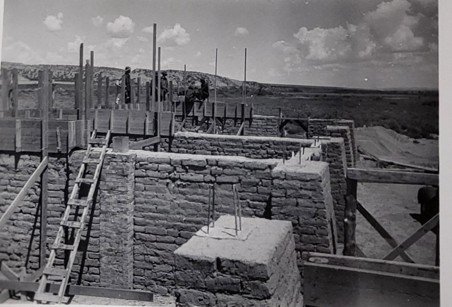
Civilian Conservation Corps crew constructing Bosque del Apache’s bunkhouse in 1941. The Refuge bunkhouse is still in use today.
Article by George MacDonell, Archaeologist / Regional Historic Preservation Officer, U.S. Fish and Wildlife Service, Region 2
At President Franklin Roosevelt’s inauguration in 1933, a quarter of the American workforce was unemployed with two million people homeless and banks closed in nearly all states. Roosevelt’s campaign pledge for a “new deal for the American People” was made real with a long list of relief efforts enacted within the first one hundred days of his administration. Fifteen major laws were implemented in an attempt to reverse the country’s downward economic spiral. One of the laws included the creation of the Unemployment Relief Act, which supported programs like the Civilian Conservation Corps (CCC), a work relief program for unemployed, unmarried men aged 18 to 25.
Over 2.5 million young men served in the CCC across the country. Interestingly, ten percent of the CCC enrollees were World War I veterans. Oversight was established through the Departments of War, Agriculture, and Interior. All enrollees received $30 per month, with $25 dollars of that sent directly to an enrollee’s family.
The Great Depression was a time of considerable struggle in New Mexico with farming, ranching, mining, and railroad interests all in notable decline throughout the 1920’s and early 1930’s. New Deal programs in New Mexico were extensive, and tied to New Mexico Governor Clyde Tingley, who assumed office in November 1934. As a powerful Chairman of Albuquerque’s City Council, Tingley met Roosevelt on a Presidential visit to New Mexico in 1932, establishing a close relationship. Tingley had campaigned on the economic stimulus of automobile tourism, which is still a driving force in the state’s economy. When elected Governor, Tingley served as an important proponent of the New Deal in New Mexico, leveraging his close connection to President Roosevelt. Tingley’s years working with the State Highway Department also had given him experience with large public projects and a recognition of the importance of federal aid money.
Tingley worked at putting thousands of unemployed New Mexicans back to work and his New Deal accomplishments for New Mexico were impressive: 2,916 miles of road improvements, 277 new schools built, many county courthouses, hospitals, and other institutional buildings constructed. Major projects in the state that were funded through these New Deal programs included dams, community water services, and public sewer systems.
As the New Deal era projects were developed in New Mexico, regional architectural heritage was supported, and what is now called the Spanish-Pueblo Revival style and the Territorial Revival style were used for the majority of constructed buildings. A few New Deal buildings were also constructed in the Art Deco style, called “WPA Moderne” at the time. Several of the well-known regional architects of New Mexico were in charge of New Deal era construction projects including John Gaw Meem.
With thirty-three percent of its land under federal ownership, New Mexico had a relatively high number of CCC projects. Because of its great number of camps, it was impossible for New Mexico, with its small population, to provide enough enrollees for each camp in the state and many recruits came from other parts of the country. There were a total of 102 CCC camps in New Mexico, with camps affiliated with the U.S Fish and Wildlife Service (n=2), the Bureau of Reclamation (n=5), the Forest Service (n=32), the Grazing Service (n=17), the National Park Service (n=6), the Soil Conservation Service (n=28), the NM State Parks (n=10), and the Military with one camp at Fort Bliss, and another in Albuquerque.
On average, thirty-two of these camps operated each year, with 32,300 men from New Mexico enrolled, and more than 54,500 men employed in total. The typical New Mexican youth who joined the CCC was 18 years old, from a large family of six or more children, and had completed at least an eighth-grade education. Most had never been employed, since so few jobs were available. Two-thirds of New Mexico enrollees came from predominantly Spanish-speaking towns and villages of the upper Rio Grande Valley, where a 1935 survey found that one member in every twenty families served with the CCC.
CCC camps associated with the US Fish and Wildlife Service (USFWS) had two main functions: improvement of wildlife habitat and construction of administrative facilities. Nationwide, forty-four of the more than 500 wildlife refuges across the United States were built by CCC forces, contributing greatly to the wildlife and fish resources of the nation. Two USFWS CCC camps were founded in New Mexico: Camp FWS-3-N (which developed Bitter Lake National Wildlife Refuge (originally known as the Carlsbad Bird Refuge) near Roswell, New Mexico, and Camp FWS-2-N near San Antonio, New Mexico (which created the Bosque del Apache National Wildlife Refuge).
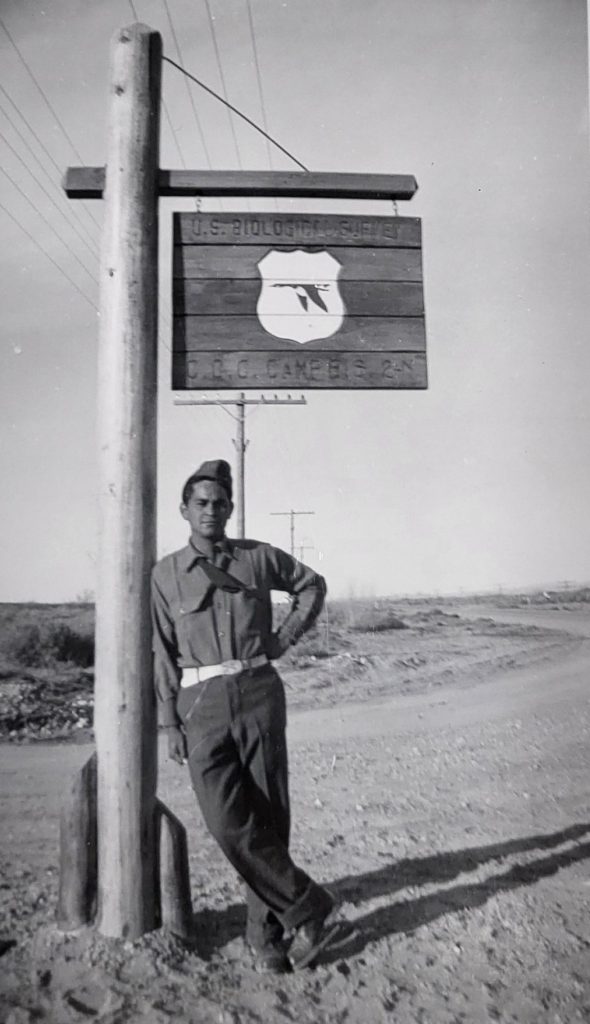
CCC enrollee at Bosque del Apache NWR.
Bosque del Apache National Wildlife Refuge was created through Executive Order by President Franklin D. Roosevelt in November 1939 from lands acquired by the federal government in 1936. These marshlands were once part of a vast land grant made by the Crown of Spain to Pedro Armendaris, in the early seventeenth century. Upstream water control efforts on the Rio Grande dating from 1914 until the establishment of the Refuge, had altered the river hydrography causing catastrophic flooding and wiping out habitat and agricultural lands. These adverse changes led to the establishment of the Refuge. The original Refuge in 1939 had 60,207 acres, lying both east and west of the Rio Grande, with the AT&SF Railway and then US Highway 85 (now NM Highway 1) running north to south on the west side of the Rio Grande. Until the Refuge was developed, the area was largely swampland where only beavers, muskrats, Canada geese, and swans survived. CCC personnel drained the swampland and levelled the land for a carefully planned Refuge.
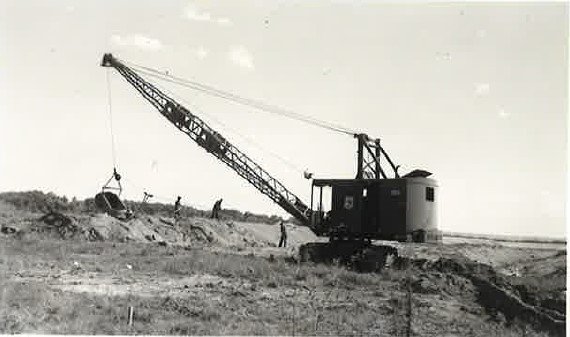
CCC crews constructing a dike at Bosque del Apache NWR.
A vast network of irrigation ditches and dikes were built to help stop the annual flooding of the Rio Grande and create wetland habitat. The creation of the Refuge has provided a home for many more mammals and hundreds of bird species, attracting famous seasonal residents like the whooping (formerly, but not presently, found at Bosque del Apache) and sandhill cranes.
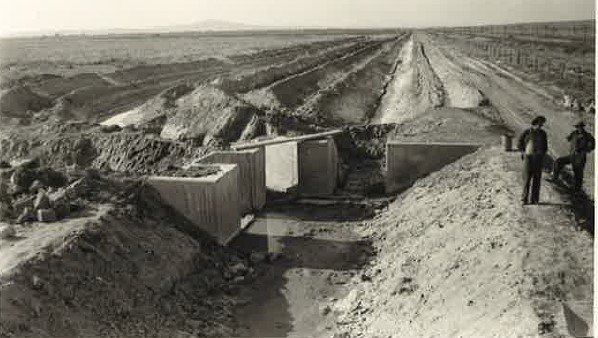
Irrigation canal and water control structure under construction at Bosque del Apache NWR.
The first Refuge Manager was Allister D. Campbell, who remained in this job for the entirety of the CCC camp work. Detailed information was kept regarding CCC enrollees, types of work completed, daily number of personnel completing tasks, and a narrative of the work accomplished. From these accounts, we can see that the majority of CCC work completed at the Refuge was focused on creating a controllable foundation that is the Refuge as we now know it: an acequia system to control water flow, channels and water control structures, trails and roads, and supporting facilities like those at the Refuge Headquarters Area, with adobe bricks and concrete blocks made by CCC enrollees.
Some of the earliest documentation of work related to the Refuge Headquarters Area buildings construction comes from the December 1939 to January 1940 report, where one crew of men, the “adobe gang,” was used continuously in making adobe bricks. Although progress was slowed by the lack of the sun to dry the bricks, they still made over 10,000 adobe bricks by the end of January 1940.
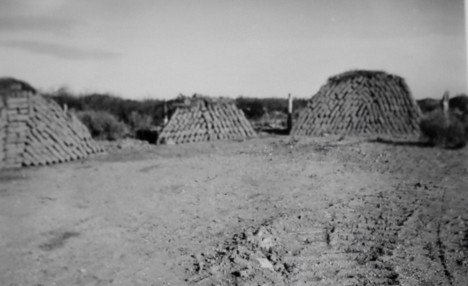
Adobe bricks sun drying in piles at Bosque del Apache NWR.
Additional adobe bricks continued to be made in February and March of 1940, which were stored in sheds until warmer weather in March. Part of the work included hauling sand, clay straw, and firewood for making the bricks. A gypsum source was also located about thirteen miles from camp, and “a large amount” collected and processed to make an “excellent grade” of plaster.
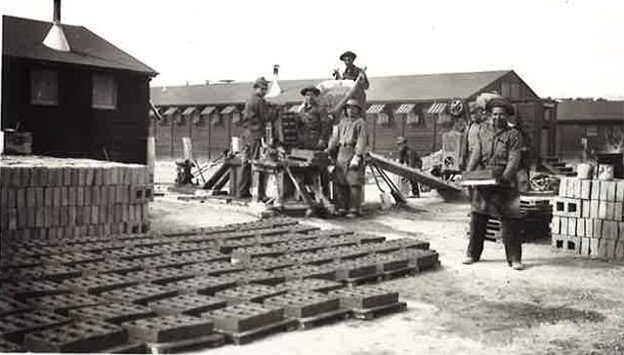
CCC crews making concrete bricks for the manager’s residence in 1942.
Mention of wood timber collection for use as vigas for building construction comes from the July to September 1940 report, and the information states that this took two full weeks, probably in July of 1940. The wood vigas were collected in southeastern Arizona near the town of Safford and the logs were transported back to Bosque del Apache.
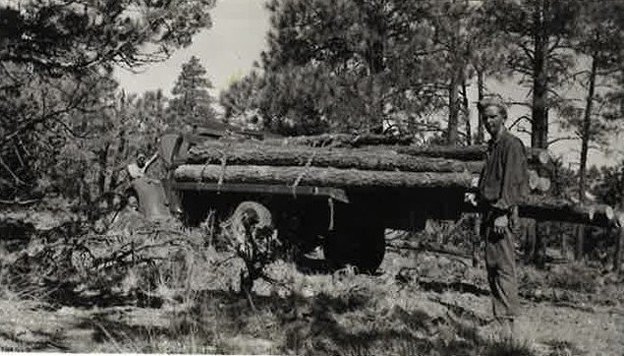
CCC crew collecting logs to be used as vigas near Safford, Arizona.
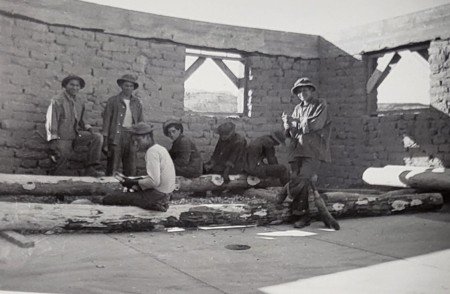
Preparing wooden vigas for bunkhouse, 1941.
What these historic CCC reports detail about building construction shows a very dynamic work schedule, with some buildings completed relatively quickly, and others taking a longer time. Names for buildings are dynamic as well, making formal attributions difficult. Known construction dates and historic names of buildings come from a 1965 Property and Building Inventory (USFWS files), which give us the final construction dates.
During the CCC construction, the first three buildings completed were service buildings that have all mostly been remodeled into other uses: “Biology Building” in 1940, “Garage” in 1941, and “Bunkhouse” in 1941. Residential buildings took much longer to complete; some were started as early as 1940 but not completed until 1942. Both the current “Friends’ House” (originally a residence) and “Residence #3” were completed in 1942. The Refuge Manager’s House “Residence #1” was completed in 1943.
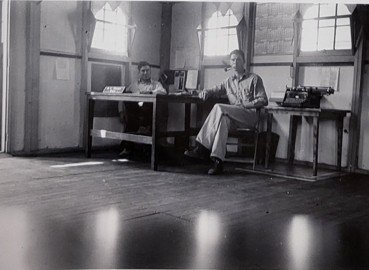
Administrative staff inside interior of completed structure, Bosque del Apache NWR.
The original construction of all these buildings is associated with one of the most nationally significant events in our history: the New Deal era special projects created during the Great Depression by Congress and President Franklin Roosevelt. While there have been recent major renovations completed on these buildings, they retain most of their original building construction and have been determined to be eligible to the National Register of Historic Places under Criterion A for their association with the New Deal era construction by the CCC, WPA, and USFWS personnel. The Refuge has continued to develop over the years, but the original CCC core Headquarters Area remains intact and is considered an historic district.
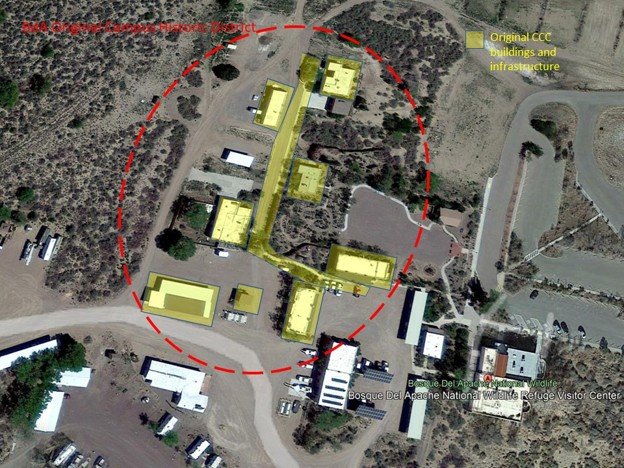
This aerial view shows the buildings as they stand today at the Refuge – the eight buildings in yellow are part of the original CCC campus and the others have been constructed since.
The end of the Civilian Conservation Corps came with the United States’ entry into World War II. The advent of the war reduced the War Department’s administrative role in the CCC, and Army officers were relieved of CCC command in order to go on active military duty. Over the next few months, some CCC camps turned to national defense work. After December 7, 1941, all camps offered work for military projects and help to the American Red Cross with war emergencies. Congress faced great pressure to abolish the CCC in 1942, and the program was formally ended on June 30, 1942.
The San Antonio, or “Bosque,” CCC camp closed in June of 1942. Their automotive equipment, including five trucks, ten dump trucks, and three broken trucks, were all given to the U.S. Army Air Force Flying School in Albuquerque. Heavy equipment was transferred to either the U.S. Army Corps of Engineers in Albuquerque (five tractors and two draglines), or to the Army Air Force Flying School in Albuquerque (a tractor, two cement mixers, three water pumps, an arc welder, a grader, a scraper, and a ripper). All remaining parts, supplies, and materials were formally transferred to the Refuge.
On July 16, 1945, the Bosque del Apache NWR was operating as a fully functioning Refuge when the military conducted the first test of the atomic bomb a mere twenty-five miles to the southeast at the Trinity Site (for reference, the observation posts for VIPs to observe the test was twenty miles away from the blast). Although no information on the test was released until after the atomic bomb was used as a weapon against Japan, people in New Mexico knew something significant had happened as the shock broke windows up to 120 miles away. Army officials simply stated that a munitions storage area had accidently exploded at the Alamogordo Bombing Range. However, the staff at Bosque del Apache NWR were well aware of the powerful test that had occurred nearby. The following is an excerpt from the Bosque del Apache Narrative Report for May 1, 1945, to August 31, 1945, submitted by Jack Sadosuk, Refuge Manager:
“The power of the first atomic bomb was tested about twenty miles due East of the Refuge headquarters in July; this nemesis of Japan had a very successful initiation as far as the Refuge was concerned. The entire area in this “desolate” part of New Mexico was brightly lighted for a period of several minutes and the Refuge buildings had their shakedown cruise in the form of violent quaking and shaking for a period of over five minutes. Occurring in the early morning hours, this release of atomic energy may not have reduced the Coot population on the Refuge, but it came close to scaring away about ninety percent of the Refuge personnel.”
The buildings and infrastructure created through the work of the CCC at Bosque del Apache NWR weathered the nearby atomic test in 1945 and continue to endure and function even to this day, for the benefit of native wildlife and the American people.