
Photo © Don Boyd
Regenerative Agriculture Project Ends Prematurely but with Good Results
Friends of Bosque del Apache embarked in Autumn 2023 on a five-year pilot project to understand how regenerative agriculture practices can be adopted as a sustainable process for restoring soil fertility and crop productivity on the refuge. The project ended in April 2026 with both disappointing and exciting results as outlined below.
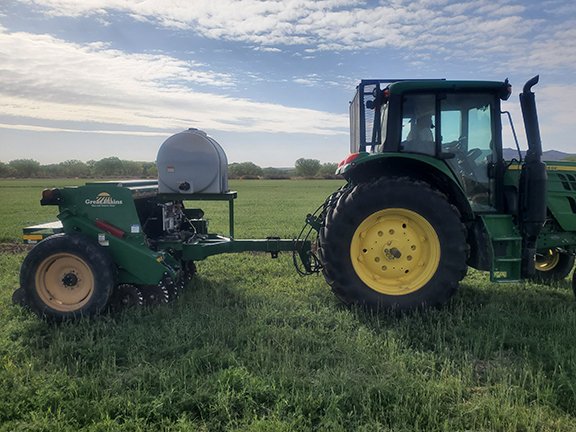 The project initially included 38 acres on the far south end of the refuge. This area was chosen as the crops in two previous years had failed despite application of traditional nutrient inputs and pesticides. The poor soil properties of the fields provided a unique opportunity to demonstrate the efficacy of regenerative agriculture practices. However, problems arose due to unleveled fields causing pooling at the lower elevations of some fields and refuge staffing shortages. The Friends then hired a former refuge employee to take over the active farming responsibilities of the project. The two northernmost fields continued to be farmed while the two southernmost fields lay fallow until we could restore them through laser leveling scheduled for late summer 2025.
The two northern fields were planted as designed in April 2025. An invasive foxtail plant crowded out the multi-species cover crop planted on the western most field following the April planting. Wanting to recover the use of this field and rid it of foxtail seed, we did a supplemental planting on this field in June 2025 of sesbania sesban, a fast growing, nitrogen fixing legume that is both drought and flood tolerant. The sesbania was very successful and grew quickly and got rid of the foxtail so that we could resume our planned October multi-species cover crop planting.
Persistent drought conditions through the late spring and early fall of 2025 made it very difficult to get water onto our two remaining northern fields and made it obvious that we were going to have insufficient water to be able to prepare and recover the use of the two southern fields. Tail waters from the Rio Grande – the water typically available to us for our project – were completely unavailable in September and October of 2025. This prevented the 2025 fall planting, effectively ending our project.
A planting in October of 2025 would have begun the third year of the BEAM project. As it was, we completed the second year with the April 2025 planting and the follow-on irrigation through July of the remaining 12.84 acre field.
And now the good news:
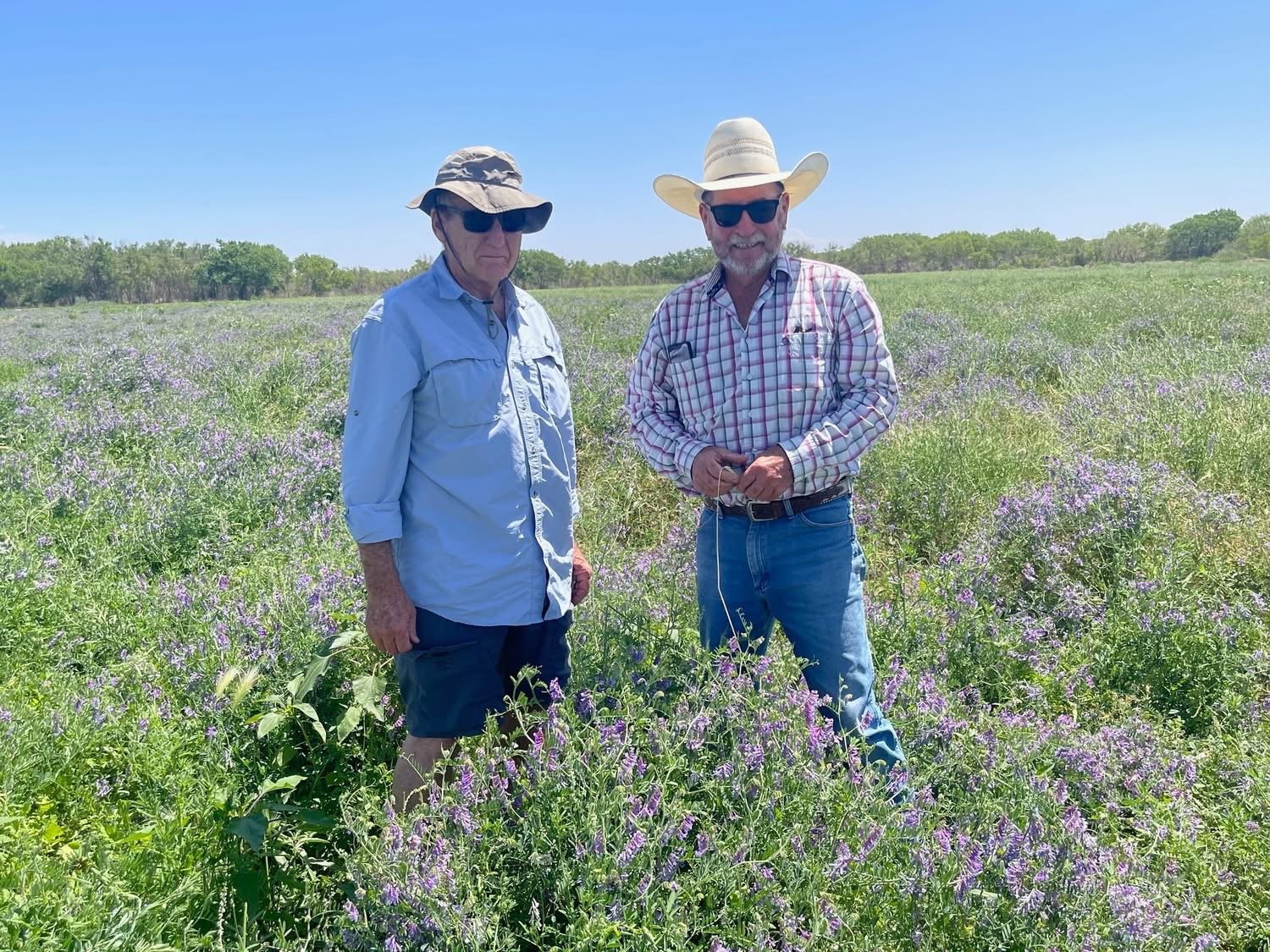 On April 21, 2026, the researchers David Johnson and Hui-chun Su, took soil samples at three different depths – 0-15cm, 15-30cm and 30-45cm – at four different locations on the remaining field. The four sampled locations were the same as those tested prior to the beginning of the project. The twelve samples were sent to a lab looking for changes in both soil nitrogen and soil organic carbon. The short-hand version is that the lab results showed that soil organic carbon had nearly doubled to two percent and nitrogen had done almost as well. Earlier research by David Johnson had showed that every 1% increase in soil carbon results in a retention of an additional 20,000 gallons of water per acre in the soil. This means the soil retains more water for plant use, reduces run-off, allows for fewer irrigations and enhances soil productivity.
Especially given the results on one field after only two years, we are very disappointed that we couldn’t run the project through the entire 5 years. Drought in the Middle Rio Grande Valley, forecast to continue in the immediate future, will make agricultural farming difficult for everyone. However, these lab results clearly demonstrate that using regenerative agriculture practices as modeled by BEAM – Biologically Enhanced Agriculture Management – can offer some resistance in restoring soil fertility and crop productivity.
Thanks for all of your support,
Don Boyd
BEAM Project Manager.