
The biology team at Bosque del Apache have been hard at work this summer conducting monitoring surveys of several of the refuge’s threatened and endangered species, as well as continuing ongoing habitat management and restoration efforts to ensure the future success of these species. This is no easy task, as habitat needs for one species can often be in opposition to the needs of another critical species. It’s a good thing this important and complex work is in such capable and expert hands!
A lot of work for a “little” (but important) payoff!
 The New Mexico meadow jumping mouse is one of several threatened or endangered species found at Bosque del Apache. Living in dense grasses along the streams of Arizona, Colorado, and New Mexico, this mouse has a bright orange color and disproportionately large feet, which they use for jumping up to three feet high, ten times the length of their bodies! The jumping mouse is nocturnal and hibernates for seven to nine months out of the year.
Federally listed as endangered in 2014, the main threat to the New Mexico meadow jumping mouse population is habitat loss, mostly from overgrazing by cattle near the streams where they live. Climate change is another driver of population loss. As we have dryer and dryer seasons, the mouse has less wetland habitat within its range.
The only known low elevation population is found at Bosque del Apache National Wildlife Refuge. On the refuge the mouse is active from late May to early October, the longest active period of any known New Mexico meadow jumping mouse population. They live in tall grasses near the canals of the refuge where they feed on as many seeds as possible to prepare for their long hibernation.
In order to monitor the mouse population at the refuge, staff members put out twenty-six trail cameras in the units that contain mouse habitat. Every five weeks the cameras are moved to a new location to try and find as many mice as possible. The cameras are out from late May to early October. This year the monitoring efforts have been successful with thirty-five detections so far (a detection is counted when a mouse is spotted on a camera that has not had any other detections that day). Previous years averaged around twenty-six detections, and detection rate does appear to be increasing slightly in recent years. The most exciting good news to come out of this year’s monitoring efforts is that this year mice where found in recently restored habitat, showing that recent habitat enhancement efforts are proving successful!
-Article by Nathan Day, New Mexico Meadow Jumping Mouse Technician at Bosque del Apache NWR
Catching glimpses of Bosque del Apache’s Endangered Flycatchers

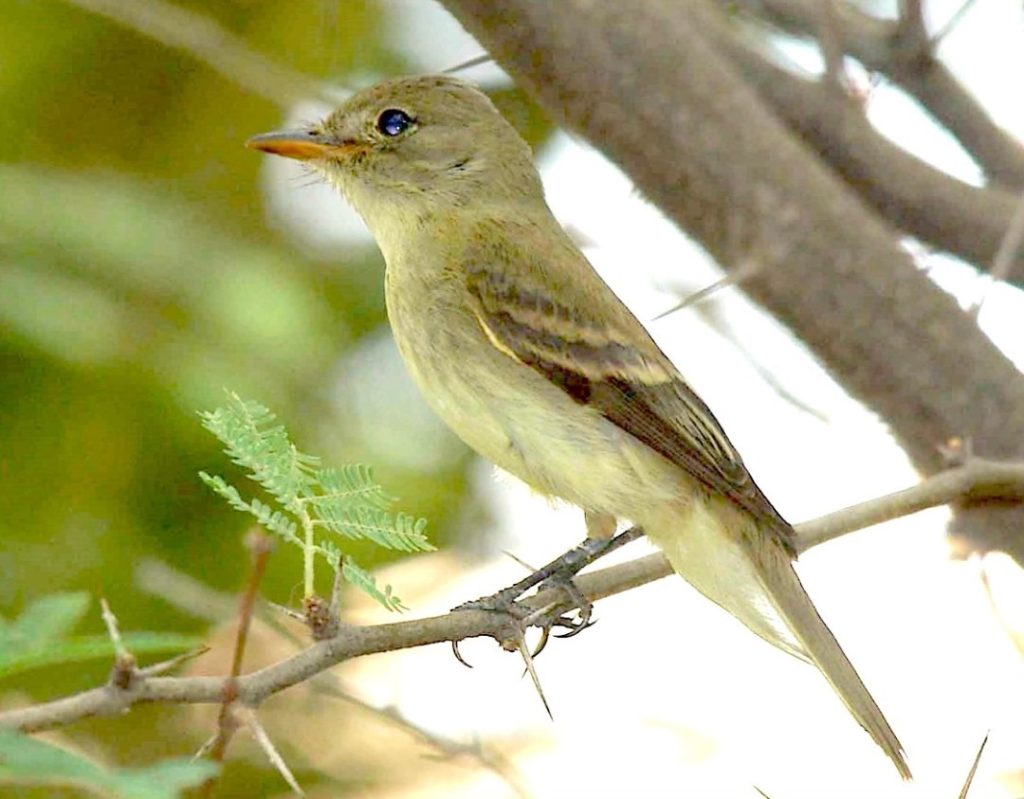
Southwestern willow flycatcher | Photo by Becky Matsubara
Waking up well before dawn, strapping on a pair of binoculars, grabbing a snack and coffee, and heading out to go birding is something lots of people do everyday at Bosque del Apache National Wildlife Refuge. In fact, people pay to do it, and that money is largely considered well spent! Thousands of people come to the refuge each year to experience a wide array of wildlife, including the famous Sandhill cranes, the herds of elk and squadrons of javelina, and maybe if they are lucky, the threatened and endangered Southwestern willow flycatcher and Yellow-billed Cuckoo. Truth be told, I would have been thrilled for the chance to experience the refuge in any capacity this summer, but luckily for me, I actually got to do the one thing that is possibly better than simply birding at the refuge – I was paid to go birding at Bosque del Apache!
HI! My name is Arthur Ludwig, and I am a staff biologist for DDC-4C, an environmental consulting company located in Albuquerque, NM. Though jam-packed full of excitement and adventure, I have had a rather short career as a biologist thus far, only dating back to the spring of 2021 when I graduated from Missouri State University, wildlife biology degree in-hand. Since then, I have had the privilege of conducting stream surveys on the west coast, rocket-netting turkeys (a very fun and long story for a different newsletter), and then joining DDC-4C (previously known as BRIC) for adventures on the Navajo Nation. 4C is a subsidiary of the Dine Development Corporation (DDC), owned by the Navajo Nation with the purpose of promoting the advancement of the Navajo Nation and its People. That being said, a lot of the work I have done for 4C is on the Navajo Nation, including noxious/invasive weed surveys, general biological surveys, and endangered Mesa Verde cactus surveys. I absolutely love working on the Nation, it has some of the most beautiful and remote nature that I have ever experienced, and it has brought me to places that are very seldom visited. There is something else, however, that I enjoy just as much, and that is getting the opportunity to explore new places and try new things… like conducting bird surveys at Bosque del Apache, for example.
This spring, we at 4C were lucky enough to have been contracted by USFWS, made possible because of considerable funding contributed by Friends of Bosque del Apache, to do presence/absence surveys for the Southwestern willow flycatcher (SWFL) and Yellow-billed Cuckoo (YBCU) at Bosque del Apache. I was exhilarated to hear the news because I am a young biologist, and this is some of my first threatened and endangered species specific work and my first professional bird surveying experience. It also afforded me the chance to explore the renowned Bosque del Apache, which is known nationwide for being a brilliant birding hotspot. So after cooling off my excitement and attending both the SWFL and YBCU survey trainings, our senior biologist, Randy Seeley and I set off to find these rare and delightful birds.
Our first trip down to the refuge started with SWFL surveys. Their migration and breeding season begins earlier than Cuckoos, starting about mid-May. Reconnaissance of the survey areas was not crucial, as the survey routes were provided to us by USFWS. SWFLs are a subspecies of willow flycatchers (WIFLs) and both are very non-descript birds. They are small enough to fit into my hand, tan-brown with a cream-yellow belly, and are basically impossible to visually distinguish from the other willow flycatchers, or audibly for that matter. All willow flycatchers sing a “fitz-bew” tune, so the only way to determine the species is by time and date of detection. They are flittery little birds that hang out in very dense willow and saltcedar thickets, making them hard to find. To make it easier, survey protocols have been developed using a call playback system, where a bird defending a nest or territory will respond if you call to it.
The survey protocol is relatively straightforward: get to the site before daylight and start walking when light enough, use a speaker to play a flycatcher “fitz-bew” call, wait for a response, record either absence or presence, and move on. It sounds simple, and with only a couple birds detected the first two days, it was. Randy and I were even feeling slightly dejected at how few flycatchers we had found. It was too simple, we thought… that is until it wasn’t! The third morning, armed with my speaker, binoculars (and coffee of course), I was dropped off at a site with particularly good habitat. Upon exiting our truck, still before daylight, I was greeted by a great cacophony of bird song. If you didn’t know, the Yellow-breasted chat has “chat” in the name for a reason, because they are LOUD and consistent singers, and let me tell you, they definitely like chatting! Chats, along with Brown-headed cowbirds, Red-winged blackbirds, Common yellowthroats, and Summer tanagers, paired with bullfrogs and rushing water nearby made for a racket so intense that the faint (and very cute) “fitz-bew” was almost not audible. In that instant, simple turned very quickly into chaos. Chaos, because I could just barely hear multiple flycatchers singing at various unpredictable intervals, and I had to determine how many individuals were present without over or under counting them, as well as determine their precise location in an area with vegetation so thick that you really couldn’t see them.
After tuning my ear and once the birds calmed down a bit, I did end up up sorting it out. The chaos, along with the joy of having found a dense cluster of these rare little birds, made for a thrilling morning and an experience that I never will forget. I like to think back on that moment in particular, especially the stress that I felt, because it is a good reminder of how important these bird surveys are, and of the importance of them being done correctly.
The Southwestern willow flycatcher has been listed as federally endangered since 1995, due to large population decline and a shrinking of range, caused largely by habitat loss. These birds must have dense willow or other vegetation of a similar structure (saltcedar), paired with moist or saturated soils. Agriculture and hydrology management over the last century has left their preferred dense and wet riparian habitat shrunken. Although they have widely disappeared from most of their historic territory, proper management practices at Bosque del Apache have protected and created habitat where they can thrive. This is where our presence/absence surveys come in, as a way to monitor how well the bird population is doing, and just as importantly, where they are doing well. Just like many other bird species, willow flycatchers are sensitive to disturbance, and enough disturbance from machines or pesky humans trying to peep at their nest could cause one to altogether abandon its nest. They also have a high nesting site affinity, meaning that they come back to the same site every year, if possible, even if they had abandoned it previously. Knowing precisely where their territories are is vital for protecting them, whether it’s to hold up projects in the area, stop direct or indirect habitat change, or temporarily close an area to the public to let the birds nest in peace.
Since their listing as endangered in 1995, different reaches along the middle Rio Grande came up with targeted population goals. While the goals have not been met in many of the reaches, the Bosque del Apache reach has long since met it goal. Thanks to the targeted restoration of quality habitat and to the size of these habitats, these birds have been able to recover well in this section of the river. That being said, if you were on the hunt to find willow flycatchers, or Yellow-billed Cuckoos, Bosque del Apache is the place to go! These birds, along with all the other wildlife you will find, are part of what makes the refuge so special. Just remember while you are out there, give these birds plenty of space, be calm and quiet, and try not to disturb them, especially anywhere near their nests. Happy birding!