
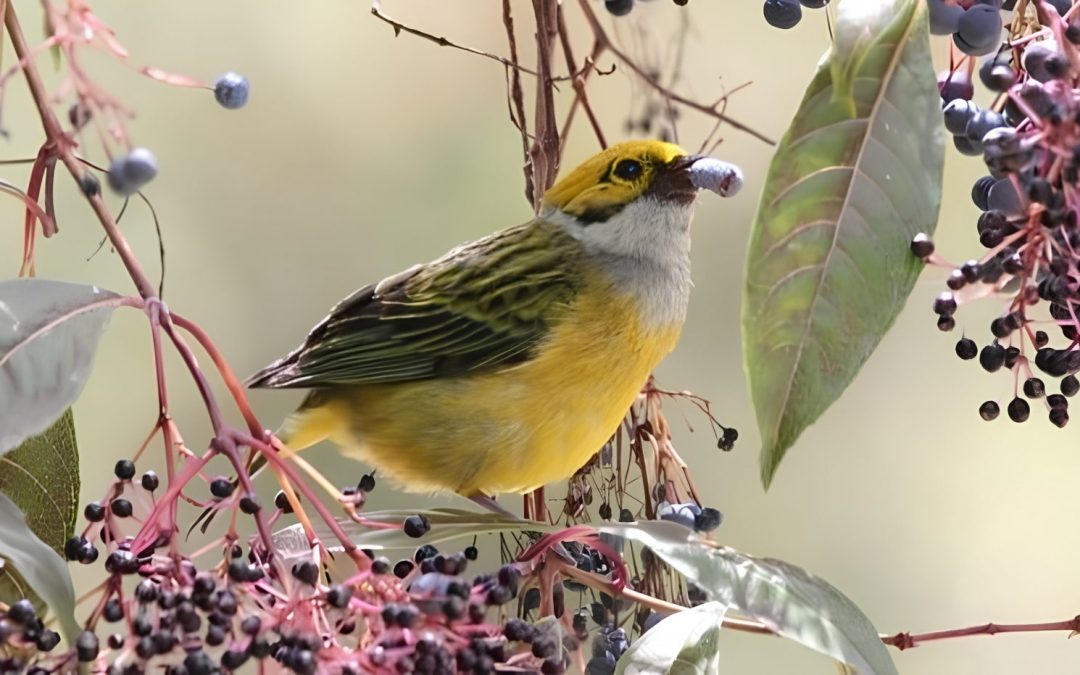
Silver-throated Tanager | Photo by Dominic Sherony, courtesy of Holbrook Travel, Inc.
What’s so great about Panama, you ask? Well, there’s the canal – built in 1914 and ceded back to Panama at the end of the 20th century – which revolutionized shipping by avoiding the necessity for seafarers to navigate the treacherous Cape Horn. And then there’s the extraordinary natural beauty, including stunning beaches and a rich and complex tapestry of diverse flora and fauna. A true crossroads of cultures, Panama offers a melding of Spanish, Afro-Caribbean and indigenous heritage and influence.
It turns out that Panama was playing a critical role in “connecting the unconnected” well before the canal. The Panamanian Isthmus was formed some three million years ago as sea levels dropped due to the expansion of the polar ice caps. In so doing, North and South America became permanently connected and the Great American Faunal Exchange subsequently took place. Most animals went North but had relatively little impact, with only armadillos and opossums surviving. Fewer animals ventured South but ironically had a much bigger impact: over 50% of the mammalian species in South America today originated from the North.
Panama is shaped like a flattened letter “S” and runs from the West, where it joins Costa Rica, to the East, where it borders with Colombia (of which it used to be a part). It’s a small country with great infrastructure and most places are only an hour’s flight from Panama City.
So, what makes Panama special? It benefits – as all countries in the tropics do – from incredible diversity of flora. Uniquely, Panama’s rain forest is relatively untouched because its economy depends mainly on offshore financial services, revenue from the Canal and tourism, so there’s no economic need to destroy the forests. In addition, for many North American birds, Panama is the limit of their Southern range and the reverse is true for the birds from South America. Consequently, some 1,000 avian species (10% of which are endemic) call Panama home for some – or all – of the year. Not bad for a country the size of South Carolina!
All of this makes Panama a great place to go birding, which is why I’m leading a birding trip there March 14 – 21, 2026. We start in Gamboa’s rain forest, move up into Boquete’s highlands and finish the trip in Panama City and the Canal. Your trip could also easily be extended at either end for even more adventure. And here’s some really fantastic news: for each traveler who joins us, Holbrook Travel will make a donation to Friends of Bosque del Apache, so it’s all for a good cause. In fact, over the course of the last six trips sponsored by Friends, Holbrook has donated nearly $14,000 to support the important work we’re doing at the refuge! So as you see, your amazing birding adventure really does support Friends of Bosque del Apache in a tangible way! You can find all the details here. I look forward to seeing you there!
Article by Jonathan Manley, Friends of Bosque del Apache Board President
About this trip
When it comes to birds, Panama boasts the highest diversity of species in Central America; the country’s advantageous location at the convergence of two continents makes it the prime respite for migratory birds from both North and South America. Spend time birding in two distinct regions—the tropical rainforests bordering the Panama Canal, and the midlands and highlands of Chiriquí Province in western Panama—for the chance to see a multitude of species at varying elevations. On this eight day adventure, you’ll explore public and private reserves, visit noteworthy birding hotspots, witness the Panama Canal’s Miraflores Locks in action and be immersed in the country’s inviting culture and natural landscapes.
Highlights
- Hike the world-famous Pipeline Road, where we’ll target species include Black Hawk-Eagle, Purple-throated Fruitcrow, Masked Tityra and hundreds of others.
- Scale the Panama Rainforest Discovery Center’s 130-foot tower for the chance to see upper canopy species, including the coveted Blue Cotinga.
- Search for the rare Resplendent Quetzal on the Pipeline Trail in Boquete, near the border with Costa Rica.
- Visit Panama’s highest elevation natural wetlands at Las Lagunas, 4,000 feet above sea level, where you may see Masked Duck, Chiriquí Yellowthroat and Crested Guan.