
By Ed MacKerrow, originally published on this website, InLightofNature.com [https://inlightofnature.com/greater-roadrunner/].

I can fly!
Greater Roadrunner (Geococcyx californianus) in flight over an irrigation canal at Bosque del Apache National Wildlife Refuge, New Mexico. Though roadrunners are built for speed on the ground, their limited flying ability is used for short bursts, often gliding from elevated perches or across obstacles. Capturing this rare moment of flight showcases the bird’s adaptability in its desert habitat. ((c) Ed MacKerrow)
As a wildlife photographer in New Mexico, I’ve had the privilege of observing roadrunners in countless situations across “The Land of Enchantment.” Their unique silhouette is often the first thing that catches my eye in the wild. Roadrunners exude a bold attitude that leaves a lasting impression.

At the right sun angle, the iridescence of the Greater Roadrunner’s feathers can be striking – showing a green hue in this photograph. Adult Greater Roadrunners have blue skin around their eyes, with a colorful patch of bare skin behind the eye that’s typically orange in the back and blue in front. The middle section is usually white in males and light to medium blue in females. These color patterns develop gradually after hatching and may play a role in sex and species recognition, distinguishing them from Lesser Roadrunners, which show crimson coloration instead of orange. The Lesser Roadrunner (Geococcyx velox) is the smaller sister species to the Greater Roadrunner (Geococcyx californianus). Found along Central America’s west coast, from northern Mexico to Nicaragua, with an isolated population in Yucatan, it inhabits arid scrub habitats up to an elevation of 3000m. Distinguished by its smaller size, unstreaked throat/breast, and buffy (not white) underparts, it overlaps slightly with the Greater Roadrunner in Sonora, Mexico. This opportunistic predator hunts various insects by running rapidly along the ground, typically under cover. Santa Fe, New Mexico. ©
Hunting Prowess: Witnessing Nature’s Drama
I have seen roadrunners skillfully catch snakes by striking their heads while dodging counterattacks, chase small birds with surprising speed, and capture lizards with precision. Their hunting technique is captivating; they stalk with cat-like stealth before making quick dashes to catch their meals. Remarkably, they can tackle prey larger than themselves, including pocket gophers and rattlesnakes, creating unforgettable moments in wildlife photography.
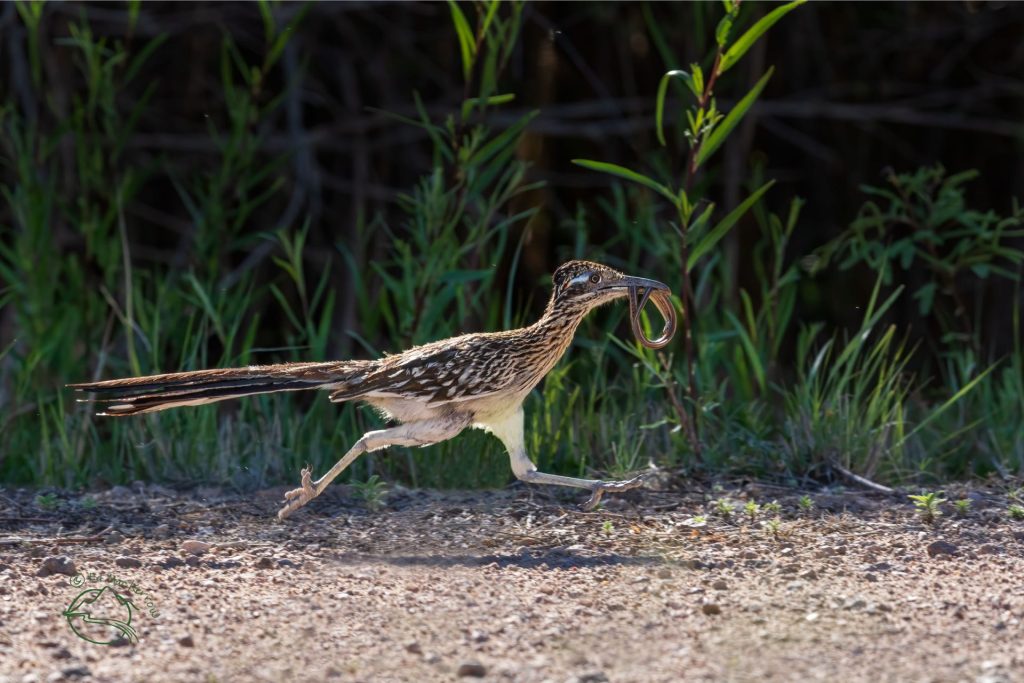
A Greater Roadrunner photographed mid-stride with a garter snake it caught. Bosque del Apache National Wildlife Refuge, New Mexico. ((c) Ed MacKerrow)
Desert Adaptations
Living in harsh desert environments requires special adaptations:
- Roadrunners can reabsorb water from their feces before excretion, maximizing water conservation
- They have a specialized nasal gland that excretes excess salt, reducing water loss
- During cold desert nights, they lower their body temperature and enter a state of torpor to conserve energy
- On cold winter mornings, roadrunners spread their wings out to reveal a dark patch that absorbs maximum warmth from the sun’s rays.
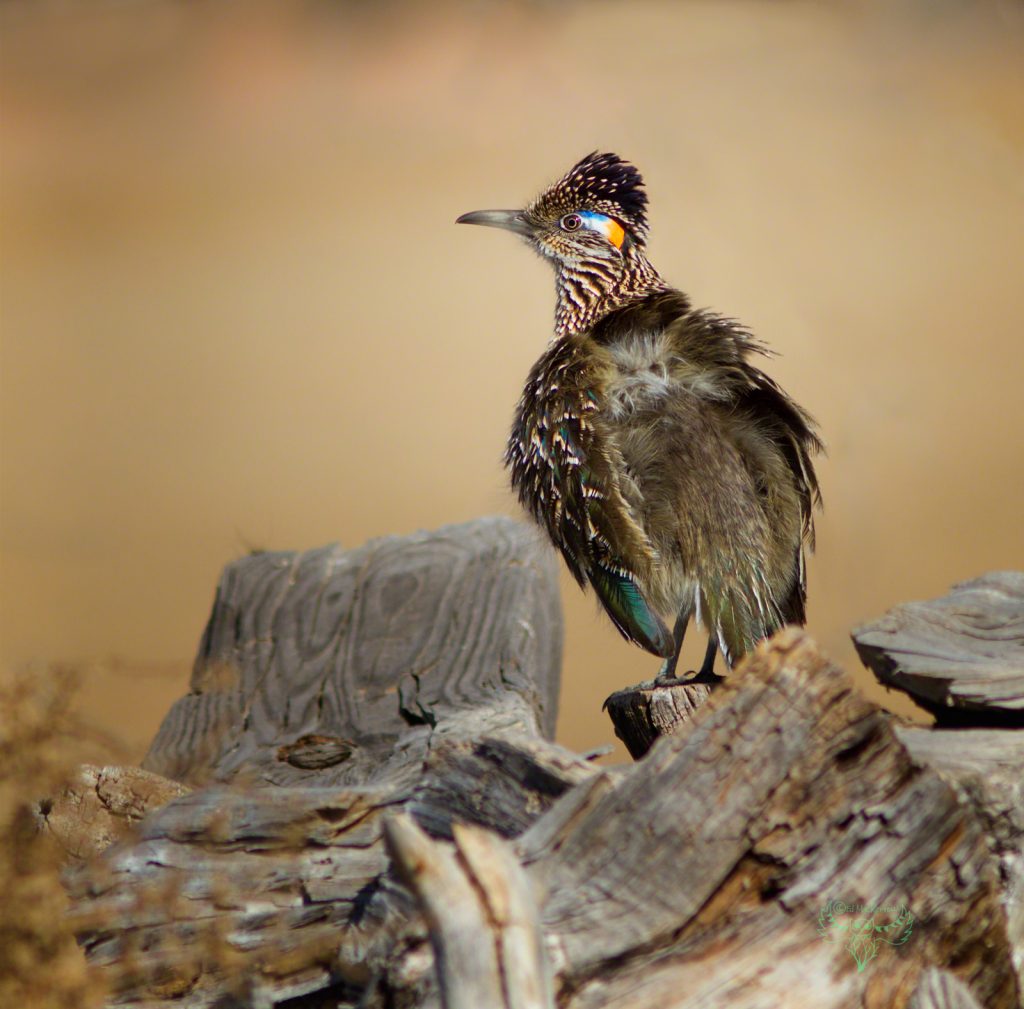
Catching Rays
A Greater Roadrunner exposes black feathers under its wings to absorb solar energy and warm itself. Santa Fe, New Mexico. ((c) Ed MacKerrow)
Cultural Significance

Beep-Beep!
A roadrunner is doing its thing, running on the road with a freshly caught lizard. Santa Fe, New Mexico. ((c) Ed MacKerrow)
The roadrunner is significant in Southwestern Native American cultures, symbolizing courage, strength, and speed. Its X-shaped tracks were believed to confuse evil spirits.
The bird also gained worldwide fame through Warner Bros.’ “Looney Tunes” cartoons featuring Wile E. Coyote and the Roadrunner. Although the cartoons exaggerate certain traits (as coyotes can outrun roadrunners), they capture the bird’s true character. Having grown up with these cartoons, I often “hear” a “beep-beep” when I spot a roadrunner in the wild.
Animation director Chuck Jones created the Road Runner cartoon in 1949, aiming to develop a new predator-prey dynamic distinct from other cartoons like “Tom and Jerry.” Inspired by real roadrunners, he designed a stylized version featuring the famous “beep beep” call, which differs from the bird’s actual cooing sound.

Roadrunners use dramatic postures, such as spreading their tail and wings, to assert dominance or defend their territory against rivals. This stance can signal aggression or an attempt to intimidate another bird or predator. In this photograph, the roadrunner is defending its territory against another roadrunner. ((c) Ed MacKerrow)
A Glimpse into Roadrunner Intelligence
One of the most remarkable behaviors I’ve witnessed in my photography career was a display of roadrunner intelligence that seemed straight out of a cartoon, but with much higher stakes. I observed a roadrunner cleverly protecting its young from a Cooper’s Hawk.
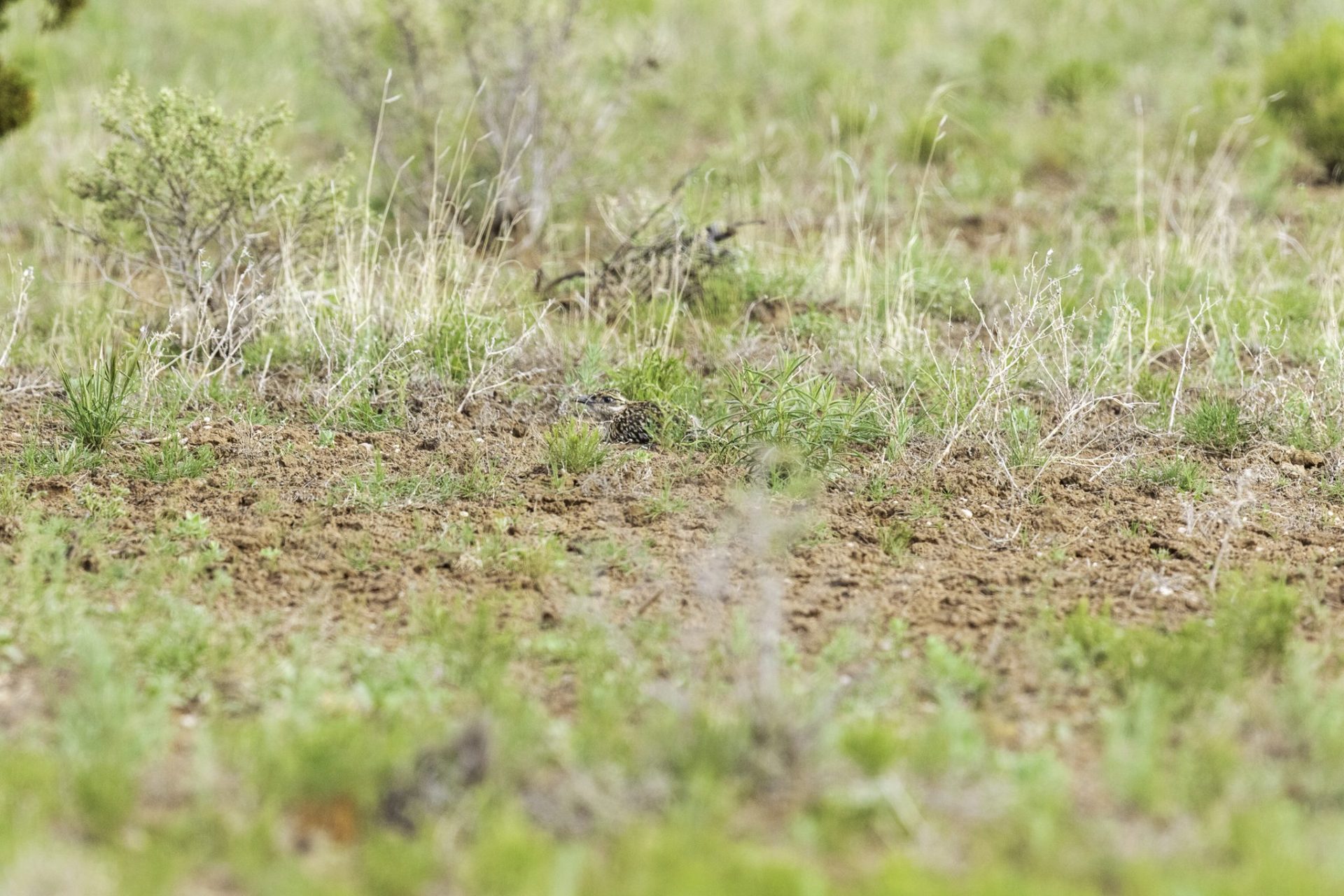
The parent teased and tantalized the hawk, drawing it away from its young, which were lying completely flat against the bare ground, their camouflage rendering them nearly invisible. The adult roadrunner ran circles around and underneath a bush while the Cooper’s Hawk repeatedly tried to pounce on the roadrunner. When the hawk got caught up in the bush, the roadrunner attempted to attack it. The roadrunner seemed to have the upper hand in this fight, as it intentionally distracted the hawk away from its young.
The good news is that the baby roadrunner was able to hide from the Cooper’s Hawk, and the exhausted Cooper’s Hawk eventually gave up and left.
-

- The roadrunner ran circles around the bush with its tail fanned out to distract the Cooper’s hawk from its chick.

-

- The young roadrunner lies motionless in the wide open while its mother distracts the Cooper’s hawk.
Declining Biodiversity with Urban Sprawl Negatively Affects the Roadrunner
Urbanization reduces the availability of large insects and small vertebrates, negatively impacting the nesting success of roadrunners. The sparse, exotic vegetation typical of urban areas may also be unsuitable for nesting. Factors like traffic, predation, and disturbances from pets can further hinder their reproduction.
Greater Roadrunners prefer breeding in less congested suburban areas with clusters of native vegetation and nearby short grasses for feeding. They are sensitive to habitat fragmentation, requiring a minimum size of 157 to 400 hectares for long-term survival, and are absent from areas smaller than 34 hectares.
They have been extirpated from regions such as the Central Valley in Northern California, the San Francisco Bay Area, coastal Marin County, Santa Barbara County, and San Diego County, primarily due to extensive residential and agricultural development.
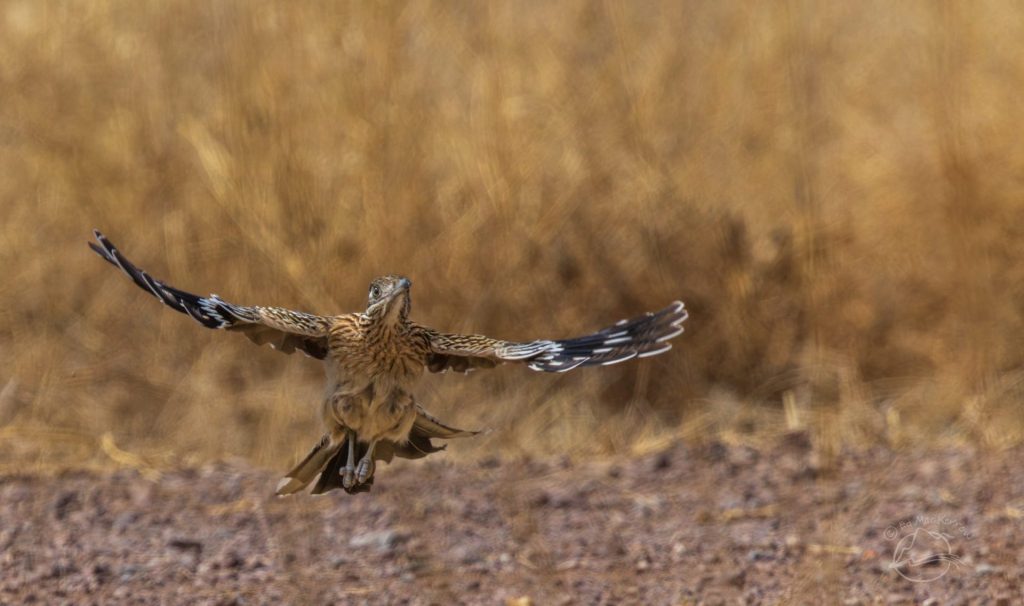
Fly fast and far, roadrunner!
After years of photographing these remarkable birds in New Mexico, I am still captivated by the Greater Roadrunner’s distinctive silhouette. More than just our state bird, it is a true desert survivor, showcasing its character, intelligence, and adaptability.
Whether you’re a wildlife photographer, a bird enthusiast, or someone who appreciates the unique wildlife of the Southwest, observing roadrunners in their natural habitat reveals how life thrives in challenging environments. Unfortunately, urbanization and habitat fragmentation are threatening their populations. I hope we can protect their habitats to ensure they remain for future generations.