
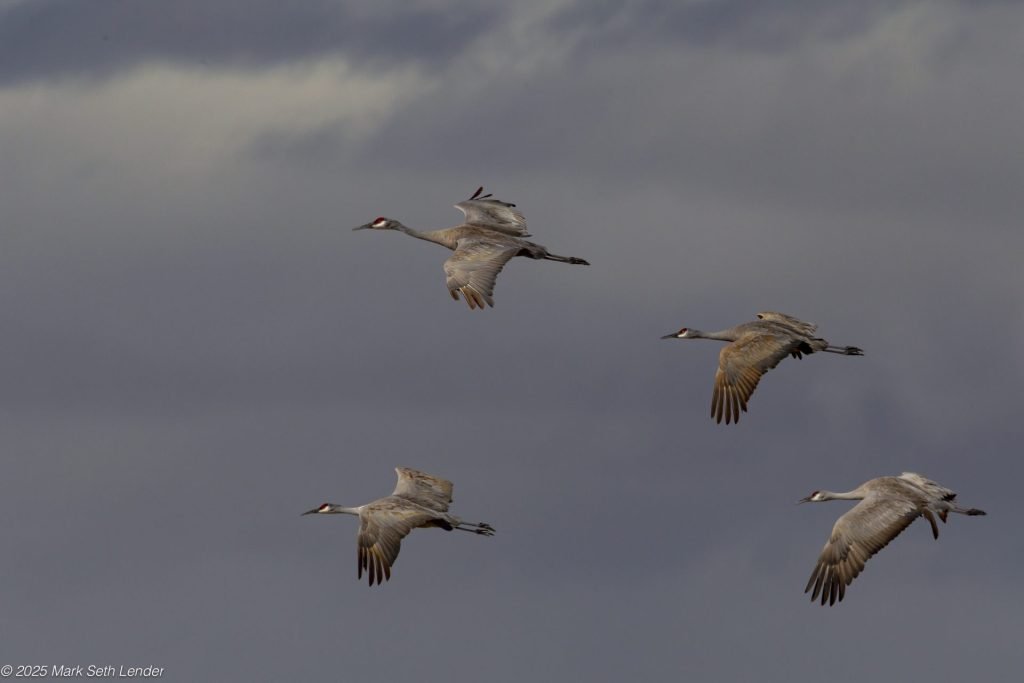
Into the Approaching Storm | Photo by Mark Seth Lender
Article and photos by Mark Seth Lender ( © 2025 All Rights Reserved)
Storks and sandhill cranes. Similar in flight. Seen overhead the long legs trailing, the beat of their wings… And that’s where it ends.
Storks evoke domesticity. When they come they come to stay.
They nest on our rooftops, atop our chimneys if you live in the right place and if your home is a house with its own roof, own chimney. But even if not. In nesting season in their Spring and Summer range they are not hard to find. The same in the opposite half of the year when they return to tropical abodes, roosting at the edge of the village in the forest trees, often in view, frequently near.
Not sandhill cranes.
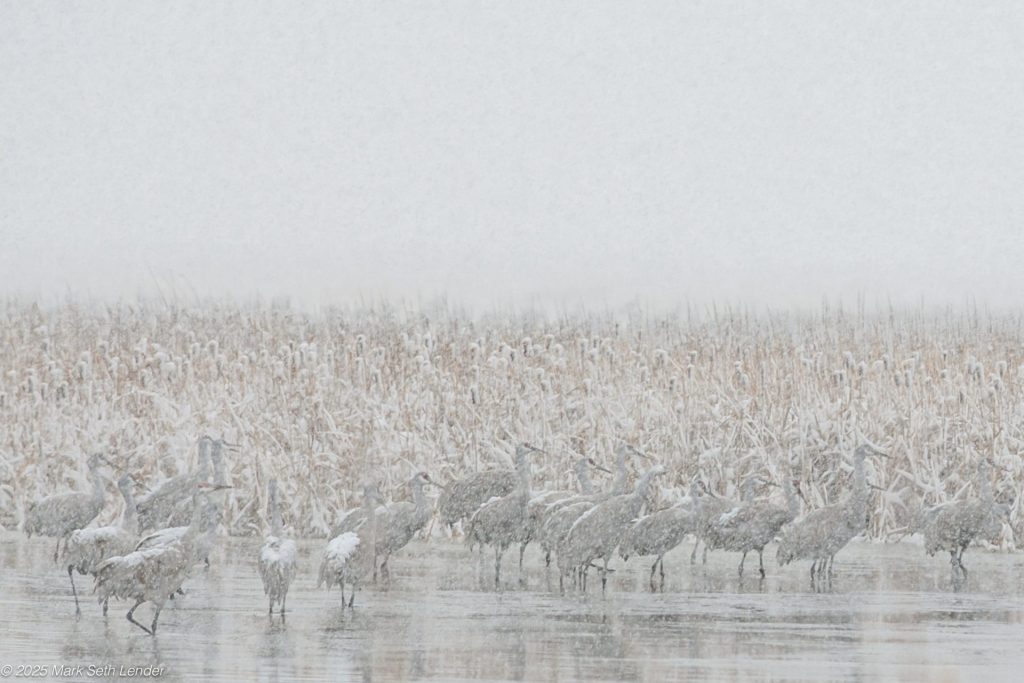
Blizzard Conditions, Ground Stop in Effect | Photo by Mark Seth Lender
Sandhill cranes breed where we are not. In northern places few of us will ever see. Where fewer still make their living and their lives. Enroute – to Siberia at the edge of the Bering Strait, Alaska above the Aleutians, West and North of Hudson Bay – sandhill cranes pass over us. A clockwork certainty. But distant. Untouchable. Unreachable. Always in transit.
Transitory.
We see them the way we visualize the Past. From Afar. Which is the source of our Longing…
The exception reclines on the cusp of winter. Those privileged to know where to seek, find in abundance. The great flocks of cranes at the Wheeler, the Platt, at Monte Vista and in the Bosque del Apache where they are fed and cared for in their winter domain, and on their way to the far reaches of the North. Visit year after year and the cranes are there. As if sandhill cranes take all this for granted. It would be more accurate to say their presence is a matter of practicality. Presented with the opportunity, they use it to advantage. They probably know, also, that we have some involvement in that. Birds and wild animals if you feed them, learn very quickly to identify you in a far more individual way than, generally speaking, we can identify them. Where I live, when the sunflower seed I scatter for the birds runs out, a pair of cardinals comes to the kitchen window, and they call me – not to feed them on the spot but to put out more seed. They have made the transitive connection between food, me, and the place I live. The fish crow, during his annual sojourn in this, his spring and summer territory, does the same except he will take food (provided it’s something he really likes) from my hand. Unless he has been presented with the same thing more than twice in a row in which case he walks away and looks at me over his shoulder.
I get the message: Variety is the Spice of Life.
And I comply.
Don’t call this what it is not. The cardinals, the crow are not my “pets.” That isn’t the relationship. I serve them. For their part they make use but do not depend. They have other choices. With the cranes, different. They do depend. And – something the animals also know – We are not dependable.
There are forces afoot to bring the National Wildlife Refuge System (NWRS) to an end, in its entirety. In the latest iteration, the NWRS budget was cut by 22% and staffing reduced to just over 1800 full time people. This shoestring crew with near-empty pockets to manage and maintain what is literally the single largest system dedicated to the conservation of wildlife, in the entire world.
What can we do.
To start, do not blame it all on the current administration. They are merely an instrument in a long line of instruments. The first drastic reduction to the federal government began with bi-partisan support in 1993, culminating with the termination of 439,000 people comprising 20% of all federal employees. In the 12 years prior to the last election, under three separate administrations inclusive of both major parties, there were profound reductions in NWRS personnel and a real-dollar decline of 30% in NWRS funding. In that same period Elon Musk acquired wealth significantly greater than the Gross Domestic Product of Hungary, greater than Greece, or Finland or Portugal, as much as Denmark, one half that of Switzerland. Don’t for a minute think the two are not connected. There is only so much money, and we are in a zero-sum game.
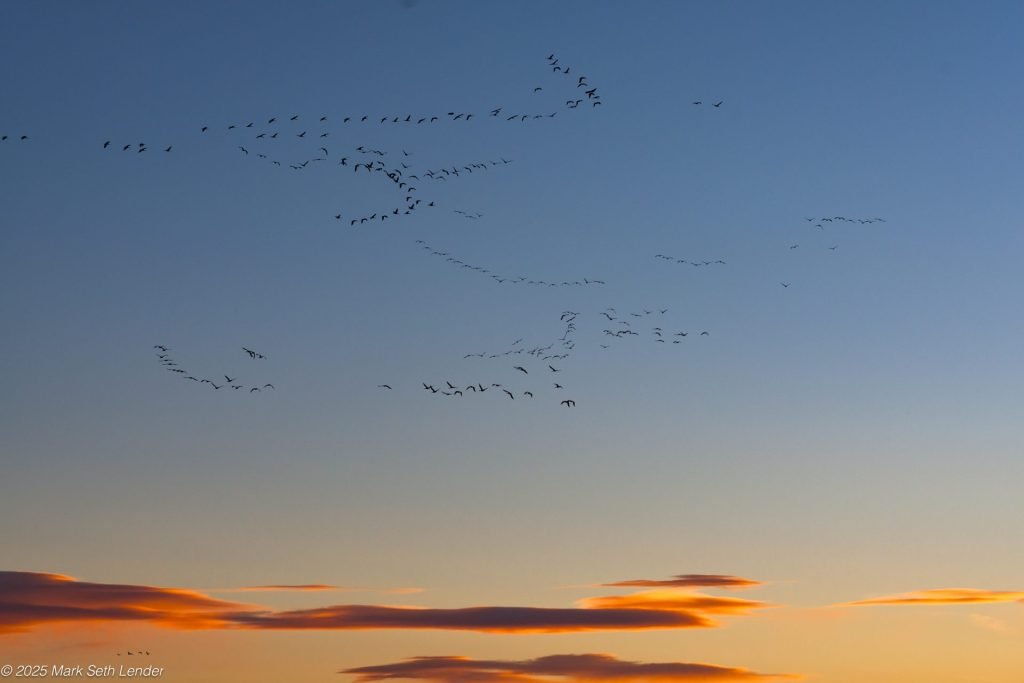
Sandhill Cranes- Flight Before Sunrise | Photo by Mark Seth Lender
What can we do…
Write to your senator. Write to your congresspeople. Your would-be governor. Insist they not reply with their “good intentions,” their form letter responses. Ask them to name specific legislation they have proposed to redress this egregious wrong done to our Public Lands! They can’t because they haven’t and they won’t, unless, enough ordinary people pledge that our votes and our financial contributions rest on this knife edge. It is one side or the other. You believe in wild places, wild things, and ordinary human beings – or you don’t.
There is no middle ground. Extinction looms. At the least, do not go quiet into the Darkness.