
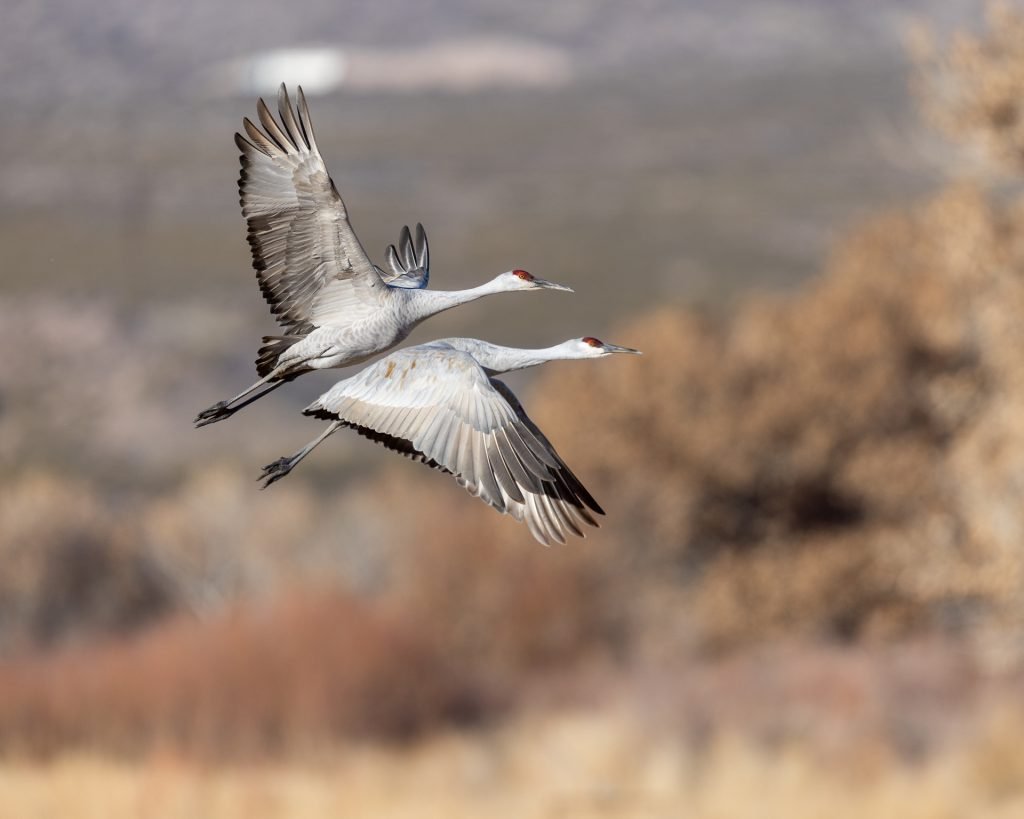
2025’s first place winner in the Sandhill Crane category of Friends’ Annual Photo Contest | Photo by William Wiener
Article by Shelli Rottschafer and originally featured on pp. 192-199 of Enchanted Outpost Magazine’s Winter 2025 edition.
Bosque del Apache National Wildlife Refuge was established in 1939 as a critical stopover site for migratory waterfowl, such as greater sandhill cranes and snow geese. The refuge is 57,331 acres with over 30,000 acres designated as Wilderness – the highest protection status for our public lands. This was a task of love and dedication, a collaboration between the BLM, the Forest Service and dedicated scientists to preserve the wild spaces in Socorro county.
To celebrate this love of land and wildlife, the Festival of the Cranes was established to observe the annual migration of thousands of cranes that frequent the area each year. It began as a one-day community event. Since then, the celebration has grown in popularity and intent. (Unfortunately, in 2025 the Festival of the Cranes was temporarily cancelled due to the longest government shutdown in US history.)
To learn more about Bosque del Apache and the Festival, we talked with Trisha Sanchez, Donor Care Manager for Friends of Bosque del Apache National Wildlife Refuge.
Trisha explained the Festival of the Cranes has grown and transformed into a five-day Festival featuring over 100 unique birding and photography workshops, tours, and hikes. It is planned and put on through the joint efforts of the Wildlife Refuge, with Friends staff and volunteers. Visitors from all over the world travel to learn more about Bosque del Apache and the magnificent sandhill cranes throughout the year, as well as in December for the crane migration.
SR: Trisha, when did you first begin working with and promoting the Festival?
TS: I began working with Friends of Bosque del Apache in the Bosque Nature Store in 2016 and then moved over to work as the Membership Manager the next year. Because Friends has a small staff (two full-time employees and six part-time employees), our roles tend to overlap. We all feel very lucky to be able to be on the refuge so often. Bosque del Apache is a hugely important habitat. One of the largest and last remaining wetlands in New Mexico!
SR: What is an example of how the Festival has changed since you began until now?
TS: During the pandemic years (2020 and 2021), we were forced to transform Festival of the Cranes into a virtual/online Festival. (Thank goodness for Zoom!) It was difficult, and we certainly missed all the face-to-face interaction. Yet, we felt very lucky to have access to technology, which allowed for the reworking of classes. We could still gather people together during a time when we all needed to be reminded of the calming effect of a connection to nature. Since 2022, the Festival has been back in person.
SR: Do these majestic, winged beings land in your own yard during migration?
TS: Yes, they do! I live a bit north in the Los Lunas area, which is still part of the Middle Rio Grande Valley, and on the cranes’ migration route – the central flyway. So, I do see cranes in my area every day during fall and winter and they are quite punctual. My family and I put corn out in the backyard for them. The cranes show up just after sunrise every morning, so no sleeping in. You can hear their bugles even from inside the house!
SR: What was it like to see your first sandhill crane?
TS: I am from Oklahoma and didn’t see my first crane until I moved to New Mexico in 2008. For me, they are fascinating and such unique creatures; it never gets old. Over the course of my time living here in New Mexico, I have learned that welcoming the sandhill cranes back to the area each fall is indeed as much a part of the annual changing of the seasons as falling leaves and roasting green chile. It would not feel like late fall in the Middle Rio Grande Valley without the sights and sounds of the sandhill cranes. New Mexicans eagerly look to the skies for their first glimpse of them returning from their migration south every year.
SR: What is the migratory route of the cranes?
TS: At Bosque del Apache, we mostly welcome birds from the Rocky Mountain population of greater sandhill cranes, but we do also see some lesser sandhill cranes as well. After spending the winter with us, “our” birds migrate up to Montana, Idaho, Canada, and sometimes even up into Alaska to nest. The lesser sandhill cranes migrate through the Midwest and into Ontario, Canada.
SR: Are sandhill cranes endangered or threatened?
TS: Thankfully, no, sandhill cranes are not currently endangered or threatened. However, their population is closely surveyed and monitored by biologists from several partner organizations within the Central Flyway, including the U.S. Fish and Wildlife Service. We know that their population is stable and that when circumstances change from year to year and location to location, they are adaptable.
SR: Do the cranes live in an extended family? Do they mate for life?
TS: Cranes do form long-term pair bonds (i.e. “mate for life”) and stay together year-round. Although, if a crane’s partner dies, it will pair up with a new partner.
SR: What is their life cycle?
TS: A crane’s life cycle begins as a hatchling. The young are called colts. They form family groups wherein the young stay with the parents for a time (usually for about 10 months or so after hatching), but juveniles are eventually driven off by the parents to find mates and establish their own territories. They will group up and merge into flocks of hundreds or even thousands of birds during migration times.
SR: Are some of the cranes tagged so that scientists can better track their migratory path? Do the same cranes return and is that tracked through tagging?
TS: Scientists with the U.S. Fish and Wildlife service do conduct annual crane banding, surveying, and data monitoring. From that, we know that cranes return each year to the same overwintering sites here within the Middle Rio Grande Valley, as well as utilizing their same nesting sites each summer at locations to the north.
SR: What is the best time of day or night to observe the cranes?
TS: Cranes tend to roost in large groups within the refuge wetlands at night, where they are safe from predators like coyotes. Then, they fly off the roost to feed in nearby farm fields during the daylight hours. Because of this behavior dynamic, the most exciting times of day to observe cranes on the refuge are usually at sunrise (when they can be observed flying off the roost in huge flocks), and just before sunset (when they will begin returning to the refuge wetlands and gathering up into small groups the night). Cranes can also be seen feeding in fields along the refuge tour loop during the day, although many do leave the refuge during the day to feed on farm fields all up and down the Middle Rio Grande Valley.
SR: How many volunteers are there for the Festival of the Cranes?
TS: The refuge relies upon an “army” of about thirty or so seasonal RV volunteers, not only to assist with Festival of the Cranes, but also to manage refuge maintenance, visitor interactions, and lead tours during the entirety of our busy season, which runs from October to February. Without their amazing dedication and efforts, we would not be able to successfully accomplish this feat each year.
SR: How many tourists, observers, and scientists does Bosque del Apache bring in?
TS: Festival of the Cranes brings in thousands of visitors to the refuge from all over the world. Bosque del Apache’s estimated annual visitation is approximately 200,000.
SR: How do you see science and creativity collaborate during the time of the Festival?
TS: Friends and refuge staff collaborate year-round with research professionals from partner organizations, including scientists and students from New Mexico Institute of Mining and Technology (NM Tech) in Socorro, New Mexico. Ongoing research projects, which regularly utilize the refuge as a resource, are looking at biomimicry for producing more efficient drones, which I think is fascinating.
Bosque del Apache also serves as creative inspiration for countless artists and photographers throughout the year, as showcased by the dozens of submissions we receive each year in our Festival of the Cranes art and photography contests.
SR: How do the cranes inspire?
TS: Here at Bosque del Apache, the cranes are sort of like “the hook”, if you will. They attract the most attention. They’re majestic and graceful. There’s something primal about their harsh, brassy call and their ancient connection to this area. They have been relying upon this land and this river for millennia; much longer than we have! They are magnetic. People are drawn to the refuge to witness their mysterious dances and the breathtaking sights of a flock of hundreds taking flight in mass, silhouetted against a brilliant New Mexico sunrise.
But once they are here, folks look around and realize that Bosque del Apache is also so much more – a magnificent and rare oasis in the middle of the desert, a true refuge in all seasons for countless species of hardy desert survivors, and we can count ourselves among them. Once you have visited the refuge and felt that soul-level peace, which comes from disconnecting from the distractions and stress of our daily lives, you sense that we were meant to be one with nature – part of it, not apart from it. It keeps people wanting to come back and experience that connectedness again and again. This is part of the magic that Bosque del Apache and the cranes provide.
Please also enjoy the following poetry selection, written and submitted by Friends supporter and the author of the above article, Shelli Rottschafer.
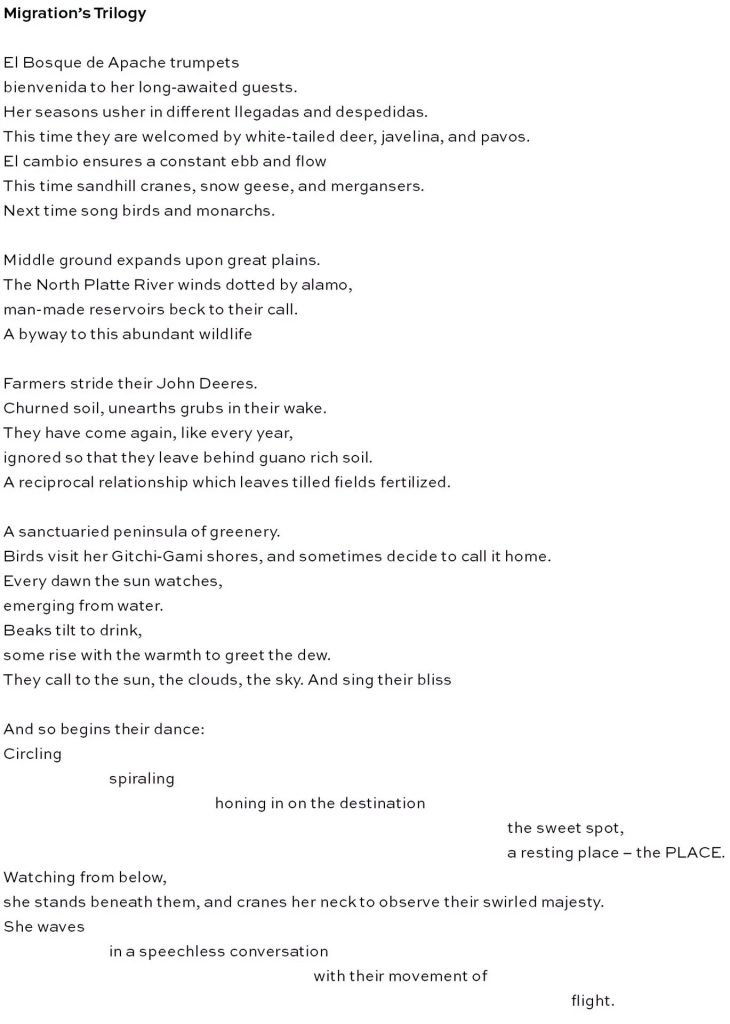
“Migration Trilogy” was originally inspired in March 2023 after witnessing the Sandhill Crane Spring migration through Kearney, Nebraska. Throughout my life I have observed Sandhill Crane during their summer month migration layover in the Upper Peninsula of Michigan. The first time I saw them in New Mexico was in the distance on the soccer field of a preparatory school where I used to teach in Albuquerque. From far away, I thought at first-glance they were goats let out to pasture, but then I realized they were the garzas on their route home to Bosque de Apache. More of Shelli’s work can be viewed on her website, shellirottschaferauthor.com/.