
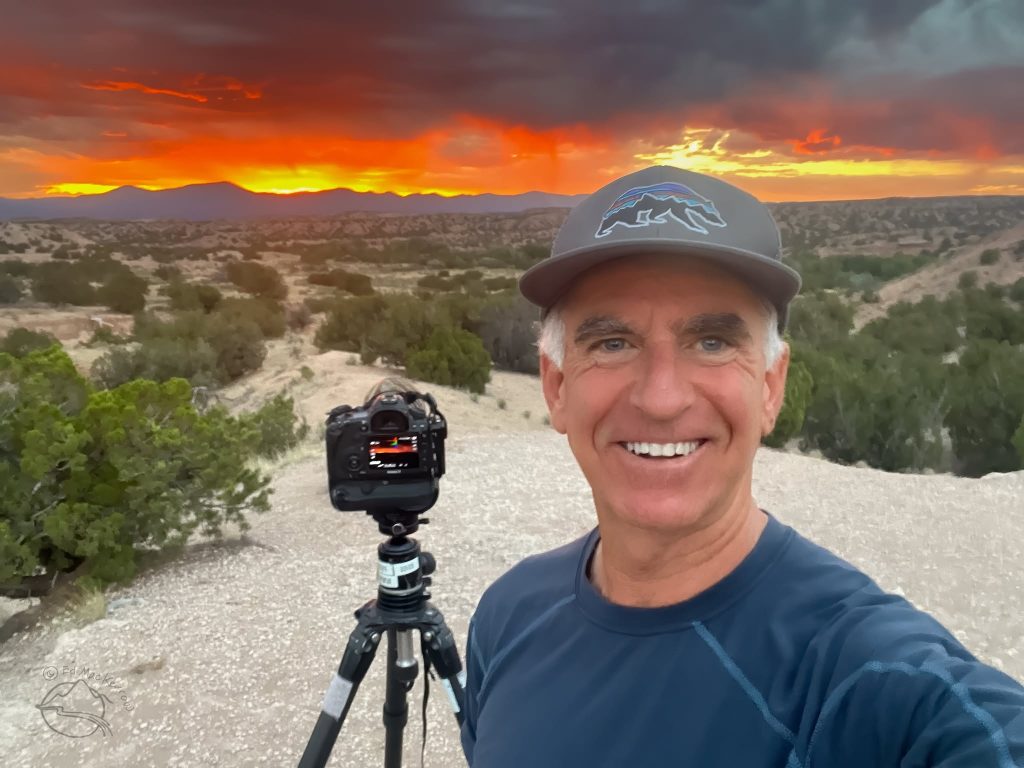
Photographer and long-time Friends of BdA member and supporter, Ed MacKerrow
Unfortunately, we must share the sad news with our Friends family that one of Friends of Bosque del Apache’s long-time members, Ed MacKerrow, passed away unexpectedly in December 2025.
Over the years, Ed, who was a photographer and passionate lifelong conservationist, was a great and very generous supporter of our organization and the refuge, freely sharing his talents and many fantastic photos with us, writing newsletter articles, serving as a photography course instructor during Festival of the Cranes, and even serving on our board several times, including as Friends’ Vice-President for a term.
We felt it would be a fitting tribute to Ed’s memory and his love for Bosque del Apache to reprise this wonderful article, which he originally wrote for our Summer 2019 edition of Bosque Watch.
Ed’s kind and generous nature and his passionate spirit will be greatly missed at Bosque del Apache. Through the end of August, his life and work are being celebrated through a photography exhibit currently on display at Co-Fe Corridor Gallery in Santa Fe (314 S. Montezuma St, Santa Fe).
The Sights and Sounds of a Summer Evening at Bosque del Apache
Article and photos by Ed MacKerrow, long-time Friends member
I am always promoting the stunning light and amazing scenery at Bosque del Apache National Wildlife Refuge, in all seasons. It is true! Any month of the year, the refuge is a nature photographer’s dream.
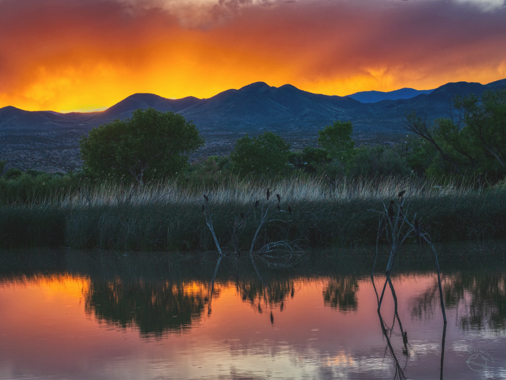
Bosque del Apache serving up its signature dish – still, reflective water; underlit clouds at sunset; with wildlife in the scenery.
Recently, I had to drive by Bosque del Apache after some field research on owls in South-Central New Mexico. My timing was right for some sunset photography. It had been way too long since I last visited the refuge and now was a golden opportunity for me to experience its beauty. Besides, I needed a break after being up all night high in the mountains recording owls.
As I entered the refuge, I was expecting to have it all to myself. In previous summer visits, this was often the case. Who else would be crazy enough to visit the refuge in the heat and with all the bugs? Drats! There were two other cars that I encountered right away. I pulled over to get my act together. At the refuge, I want to be ready. If a bobcat or mountain lion appeared while my camera was not set up, I would never forgive myself.
Now, “armed” with my cameras, I was ready to explore this amazing place. I left the windows of my truck rolled down so that I could quickly photograph any elusive cats that might appear. Oh yes, now I remember… those damn mosquitoes! As my truck filled up with mosquitoes, the bloodsuckers began biting my neck, hands, and arms.
I regrouped again. The light was just starting to get good too. The mosquitoes were serious — a thousand times worse than my worst bug days in Alaska.
Now, with a long-sleeved shirt, doused in citronella, a mosquito net over my head, and gloves on, I was ready. Driving with a bug net on, while the interior of my truck was one thick cloud of mosquitoes, was starting to verge on the ridiculous. Those mosquito head nets are also not my thing.
This is not working – the bugs are now so thick that the inside of my windshield is covered with them, and I am too tall to wear a mosquito hat in my truck. Even though the temperatures are in the nineties, I decided to go with my Alaskan bug avoidance technique. I bundled up with thick clothing, including wearing a jacket with a hood, and I covered my face with a Buff or bandana.
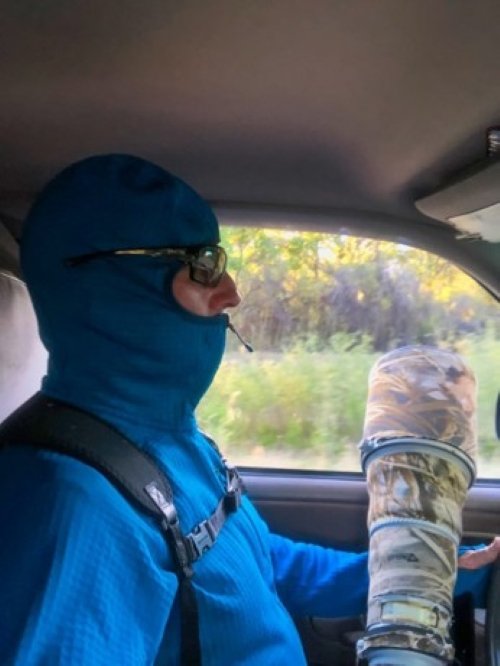
Now I am ready to rock with minimally-exposed skin. Never mind wearing a warm jacket in 98-degree heat!
Although the refuge was basically void of other people, one of the other vehicles decided to follow me. When I am at the refuge, I like to take my time and not feel rushed, always looking in the rear view mirror concerned about people behind me. So, I pulled over again and stopped, waiting for the follower to move on.
Finally, I was alone. Although at this point, I must sound like I have antisocial tendencies, I am actually quite an extrovert. When I am out photographing nature, I like to get into the “zone”, where I can listen, watch, and be in tune with nature. I think this helps to get the best nature photographs. When other people are present, it is hard to get in that zone.
While sandhill cranes are the iconic bird of autumn at Bosque del Apache, egrets are the iconic birds of the refuge in summer. Many different species of egrets can be found in the ponds and lush green flooded fields in the summer. Look for the elegant Great Egret, the tan and white Cattle Egret, and the Snowy Egret.
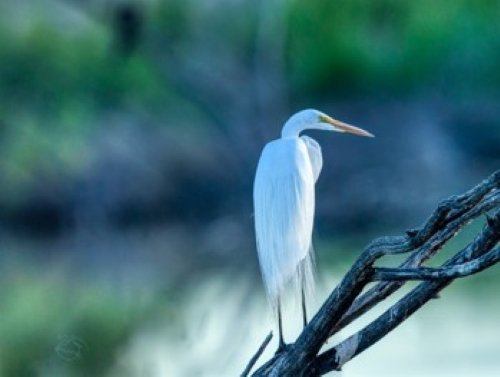
A Great Egret perched in the soft pastel afternoon light.
By now the sun was setting over the mountains west of Socorro, and the light was going to be awesome. No wind means the water reflects the color of the sky. If the sun can illuminate the underside of clouds as it sets in the west, the colors will be intense. The long path-length that the sun’s rays travel through the clear, dry air of New Mexico optimizes the amount of Rayleigh Scattering. This type of scattering is more efficient at scattering the shorter wavelengths (blue). After the long path-length through the atmosphere when the sun is low, most of the blue light is scattered away from us, leaving warmer reds and oranges. If the reddened light illuminates a cloud, especially the undersides, we see the bright reds and oranges in the sky. When there is a body of still water, it acts like a mirror reflecting red light from the distant clouds back to our eye.
Finally, I was where I wanted to be — alone, at a pond reflecting bright red and orange light, while egrets, cormorants, and grackles flew in to roost for the night.
Not only was the intense light amazing, but also the sounds from the birds and frogs in the pond complemented the light show. I stood next to my tripod in awe of the life force in front of me. Nighthawks filled their bellies with insects as they swooped back and forth above me through the clouds of insects. Bullfrogs croaked, grackles whistled, and other critters made sounds I could not identify.
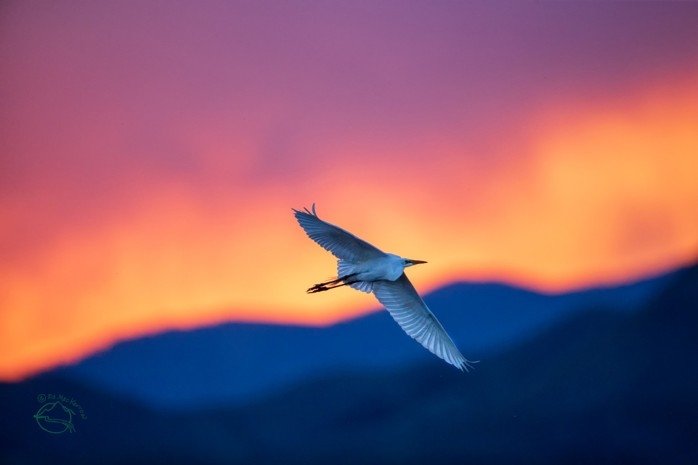
Great Egret coming in for the night roost. The colors in the sky grow redder and more saturated well after sunset. Hang out an extra twenty minutes and you will be rewarded (real colors!)
Using a very fancy wildlife microphone, I recorded the sounds of the pond at sunset. These sounds are not just random noises; instead, they are used by the birds, and frogs, to communicate with each other. Pondering how an individual can filter out all the unimportant noises to listen for their mate is mind-blowing.
I could feel the ground temperature equilibrate with the air temperature. This occurs twice per day and lasts only about ten minutes. During this time, the air is calm and still. Atmospheric turbulence is at a minimum during this time and helps improve image quality and the camera’s focusing ability.
Surprisingly I only suffered a few mosquito bites. When the light show faded, I began my drive home, stopping at a car wash to clean off the layers of bugs so that I could see out my windows.
Now, in the cool New Mexico night air, with my windows rolled down, I relaxed as I watched twilight turn to a star filled sky. I thanked “Betsy,” my reliable old Toyota Tundra with 350K miles on her, for getting me there and back.
Betsy has traveled thousands of miles of rough dirt roads and I told her that I would replace her suspension soon. I felt a bit nervous on the four-wheel drive roads driving up into the high mountains!
When I arrived at home north of Santa Fe, the night air was cold, and I could see the snowy peaks behind my house glowing in the darkness. Ahh, I was safely home from another rewarding experience in the Land of Enchantment. As I fell asleep, I could still hear the rhythmic sounds of the Mexican Whip-poor-wills from the dark forest.
Tips for visiting Bosque del Apache in the summer:
- The best light occurs before sunrise and after sunset.
- Windy days help with the bugs; however, the mirror reflections from still water are lost.
- Look for shorebirds on the edges of the flooded fields.
- Keep an eye out for rattlesnakes, being careful not to run them over on the refuge roads (they belong).
- Find a nice shady spot to sit and wait; wildlife will show up and you will be ready to photograph it.