
Article by Sarah Hendrickson, former Friends of Bosque del Apache Board Member
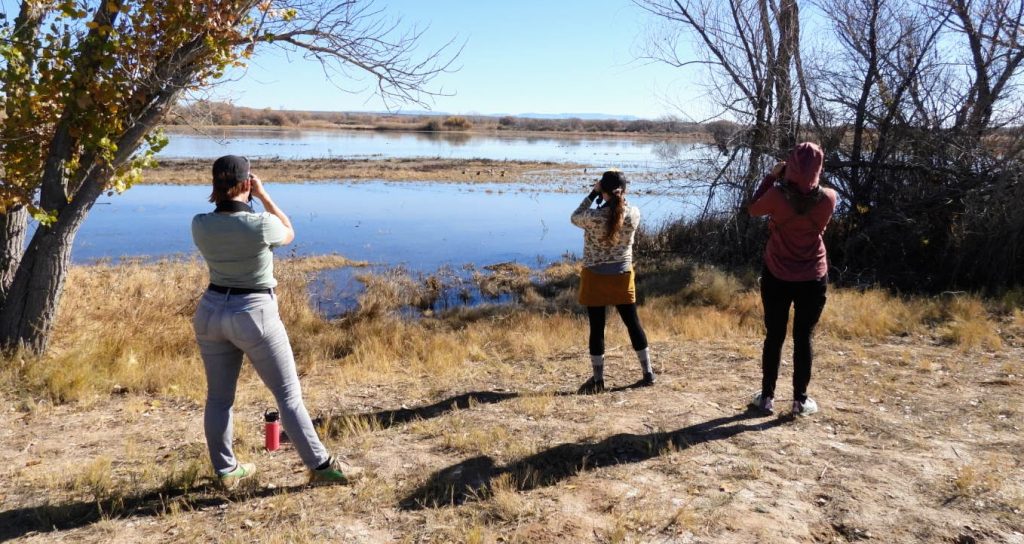
Young birders Shannon, Emily and Ashley (L to R) enjoy birdwatching at Bosque del Apache’s Flight Deck. | Photo by Sarah Hendrickson
If you’ve noticed more Millennials and Gen Zers with binoculars at Bosque del Apache NWR lately, you’re not the only one. Birdwatching, long associated with retirees, is now experiencing a boom among younger generations, and the data backs it up.
The numbers are hard to ignore
A study commissioned by the Royal Society for the Protection of Birds found birdwatching participation up 47% across all age groups since 2018, and among 18-24 year olds specifically, the surge was 1,088%, suggesting roughly 750,000 new young birders in Britain alone [1]. That youngest cohort is the sharpest data point, but it’s really the leading edge of a much wider wave. In the United States, the U.S. Fish and Wildlife Service found that 96 million Americans aged 16 and older, or 37% of that population, went birding in 2022, and the number of birders more than doubled between 2016 and 2022, with both Millennials and Gen Z driving a large share of that growth [2].
Technology is a huge part of the story. Merlin, the free bird ID app from Cornell’s Lab of Ornithology, has been downloaded 40 million times since 2014, and the lab’s eBird database has now logged 2 billion observations worldwide [3]. Cornell reported a 40% jump in U.S. Merlin usage and a 70% jump in Europe in spring 2025 alone [3]. Apps that let you point your phone at a bird, or hold it up to a birdsong, have turned identification from a skill that took years of practice into something instantly accessible, which matters a lot to a generation that grew up with a smartphone in hand.
Why are Millennials and Gen Z picking it up? Researchers and birders themselves point to a mix of reasons: it’s cheap in an expensive economy, it gets you outside and off a screen (even though a screen often helped you get there), and it offers something to focus on that feels calmer and slower than the rest of digital life. One recent analysis noted that younger generations have come of age amid economic strain, global conflict, and climate anxiety, and birding gives them something rare: an activity that’s nearly free, always available, and genuinely restorative [4]. Many also describe it as a gateway to noticing environmental change firsthand, from shifting migration timing to which species show up, or don’t, in their own neighborhoods.
Money is following the birds, too
The trend can be seen in spending as well as participation:
- The global bird feeder market was valued around $1.09 billion in 2024 and is projected to more than double to $2.17 billion by 2035 [5].
- The broader wild bird products market (feeders, houses, food, and accessories) was valued at $4.76 billion in 2024, with continued growth projected through 2035 [6].
- The birdwatching optics market (binoculars and scopes) was worth roughly $1.13 billion in 2021 and is projected to reach $2.12 billion by 2033, with manufacturers now racing to add smart and AI-assisted features aimed at this new wave of tech-comfortable Millennial and Gen Z buyers [7].
- Birding-related activity in the U.S. is estimated to support around 1.4 million jobs [7].
Youth-focused birding organizations are multiplying too. Young birders clubs now operate in states from New Jersey to Florida to Virginia to California, most founded or expanded in just the last decade, run by and for kids and teens, often with adult mentors and a strong conservation and citizen-science focus [8]. Audubon on Campus had ten chapters in the United States in 2019; it currently has 130.
The impact of “Listers”
If there’s a single piece of pop culture that has supercharged the moment, it’s probably “Listers: A Glimpse Into Extreme Birdwatching,” a documentary by brothers Owen and Quentin Reiser that dropped free on YouTube in August 2025 [13]. The film follows the two, who started out knowing almost nothing about birds, as they attempt to break the Lower 48 Big Year record. It has been praised for its humor and cinematography and has pulled in millions of views, including plenty from people who had zero prior interest in birds [14]. It has become something of a shared cultural touchstone in birding circles this year, both loved and gently ribbed for how it portrays the more competitive, “listing” side of the hobby.
My friend Ashley stumbled onto “Listers” through her YouTube algorithm back when it had only about 100,000 views. “I cackled all night watching it,” she said. Ashley has become deeply invested in the apps that make modern birding possible. “I’m really dependent on the apps, to confirm IDs as a new birder” she admits, and she’s candid about what the hobby gives her right now: “Time feels like it is slipping away from me lately, and birding helps slow things down and be in the moment.”
Another birding friend, Emily, sees the tech question with more nuance. “I bet the general surge in the younger generation is related to the broader movement seeking more analog hobbies and experiences as AI is being forced upon us constantly,” she said. “Although the apps really do help lower the learning curve by identifying hotspots and providing real-time identification, Merlin is essentially Shazam for birds! So it’s not completely severed from technology, but at least this use of AI augments curiosity rather than replacing it.” For Emily, birding scratches several itches at once: “The primal thrill of the hunt for a target bird, the accessibility, and vital citizen science.” She also loves what it has taught her about her own backyard: “I love getting to know our local birds and their behavior[s] and flight patterns. Being able to identify the general type of bird from a distance based on how it flew in, or its shape or call, makes me feel more in tune with my surroundings.” And birding has changed how she experiences the world more broadly: “It’s been exciting for my brain to pay attention to an extra layer of the world that I wasn’t tapped into before.”
Birding as identity, and as connection
For my friend Shannon, birding started in an unlikely place: Chicago. “I got into birding living in Chicago, objectively a place where nature has been pushed to the margins,” Shannon said. “But the longer I lived in the city, the more I craved nature. Birds became an easy way to engage with nature wherever you are, even in the city.” A friend who was already a birder brought Shannon along to Humboldt Park, a well-known migratory stopover. With little more than a field guide and a pair of subpar binoculars, Shannon said they “wandered around bushes trying to ID warblers that are so fast and tiny, it felt impossible. But overall, birding is free and simple. You just show up where you are, and it requires you to pay quite attention. That’s what I love about it.”
Shannon also finds something restorative in it that goes beyond hobby. “I work in a very intense environment where I deal with life and death situations every day, so it’s a means to disengage. I also am becoming more aware each time I am in nature what the earth is telling us. So, birding as meditation, birding as healing, birding as liberation.”
I met Shannon at a dinner to remember a close mutual friend. Somehow, at a gathering full of grief, birding still found a way in. As Shannon put it: “Being approached after a funeral to talk about birding was certainly a next-level birding experience. One where I realized it is part of my identity now. Like, ‘Hey, I like birds and so do you!’ And because of it, I get to have a dope group of friends who bird, and a shared text thread. I think that is golden.”
That, in the end, may be the real story behind all the statistics. Birding is spreading fastest not through marketing or apps, but through people bringing their friends along, one shared sighting, one conversation, one group text thread at a time. Whether they found it through a viral video, a documentary, or a friend with a spare pair of binoculars, this new wave of birders is showing up, paying attention, and, if we’re lucky, becoming lifelong advocates for the birds and the wild places that need them. As Emily shared her hopes for the future, “I hope the uptick in birders ultimately helps the birds.”
Sources
- The Week, “Why birdwatching has become a favourite pastime for Gen Z,” theweek.com/culture-life/books/birdwatching-birds-app-nature-gen-z-hobby
- AOL, “Why Gen Z Is Suddenly Obsessed with Bird-Watching” (citing U.S. Fish and Wildlife Service 2022 survey data), aol.com/articles/why-gen-z-suddenly-obsessed-211202335.html
- CNN, “Why Gen Z is going bonkers for birding,” cnn.com/world/gen-z-birdwatching-boom-intl-spc
- ZME Science, “Birdwatching Is Making a Big Comeback and You’ll Never Guess Who’s Leading It (It’s Gen Z),” zmescience.com/science/news-science/gen-z-birdwatching-boom/
- Market Research Future, “Bird Feeder Market Size, Share, Report, Forecast 2035,” marketresearchfuture.com/reports/bird-feeder-market-29548
- Market Research Future, “Wild Birds Products Market Size, Share, Growth, Report, 2035,” marketresearchfuture.com/reports/wild-birds-products-market-36690
- Amra and Elma LLC, “Top 20 Bird Marketing Statistics 2025,” amraandelma.com/bird-marketing-statistics/
- American Birding Association, “Connect with Other Young Birders,” aba.org/connect-with-other-young-birders/
- Audubon, “Kids No Longer Have to Bird or Feel Alone, Thanks to This Club,” audubon.org/magazine/kids-no-longer-have-bird-or-feel-alone-thanks-club
- Deseret News, “Gen Z: Young people pick up the old hobby of bird watching,” deseret.com/magazine/2025/05/15/bird-watching-captures-new-generation/
- Yahoo/GMA, “Samuel Henderson Mastered 132 Bird Calls by Age 12,” yahoo.com/lifestyle/articles/samuel-henderson-mastered-132-bird-155357638.html
- Audubon, “Meet the Kid Who Wowed the Internet With His Incredibly Accurate Bird Calls,” audubon.org/magazine/meet-kid-who-wowed-internet-his-incredibly-accurate-bird-calls
- Wikipedia, “Listers: A Glimpse Into Extreme Birdwatching,” en.wikipedia.org/wiki/Listers:_A_Glimpse_Into_Extreme_Birdwatching
- Slate, “Listers on YouTube: The hilarious new documentary about extreme birdwatching,” slate.com/culture/2025/09/listers-documentary-youtube-birding-birdwatching-movie-ebird.html