
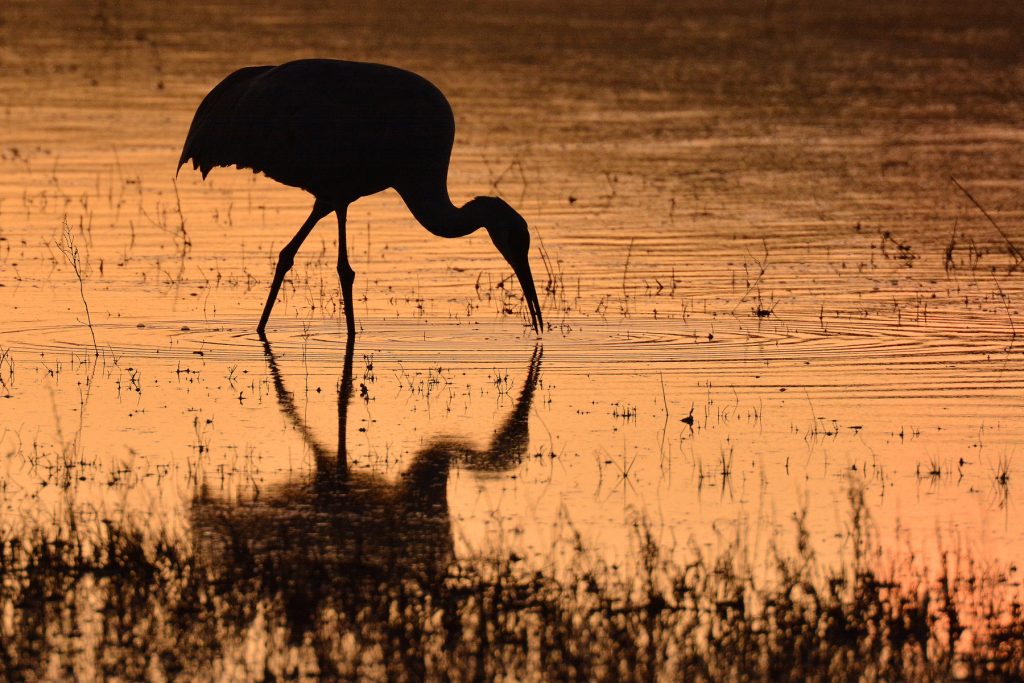
The Bosque del Apache wetlands, marshes, and moist soil units provide a critical respite and sanctuary to many thousands of migratory birds on their long journeys in both fall and spring every year; they also provide year-round refuge to countless resident species whose entire survival depends upon these life-giving waters in an otherwise harsh and unforgiving desert climate. | Photo by Terry Endo
Last month, in honor of Valentine’s Day, we turned our monthly Bosque Watch newsletter into a “Love Letter the the Refuge.” Now, in honor of our Water for the Wild campaign, which kicked off March 1st and aims to raise enough funds to assist Bosque del Apache with the repair and/or replacement of aging but critically important water control infrastructure, we are dedicating this month’s newsletter as an homage to the refuge’s vital wetlands. (For more on the critical importance of the Rio Grande, please watch this video by our partners at Intermountain West Joint Venture.)
In this article, we hear first from Friends Board President, Jonathan Manley, who highlights the global importance of wetlands and the growing use of rewilding as a successful conservation technique. Next we hear from Kevin Cobble, former Bosque del Apache Refuge Manager and current Friends Board Member, who takes a closer look at the water situation specific to the refuge and expounds upon some of the challenges staff are facing today in their conservation efforts.
We are finding ourselves at a historical crossroads, and one fact remains increasingly clear: the wetland, marshy, and moist soil habitats at Bosque del Apache are rare, precious and irreplaceable jewels. For the health of the entire region, they must be preserved for future generations, and it will take all of us caring and offering support to ensure their continued existence!
Wetlands and Rewilding: who knew?
by Jonathan Manley, Friends of Bosque del Apache Board President
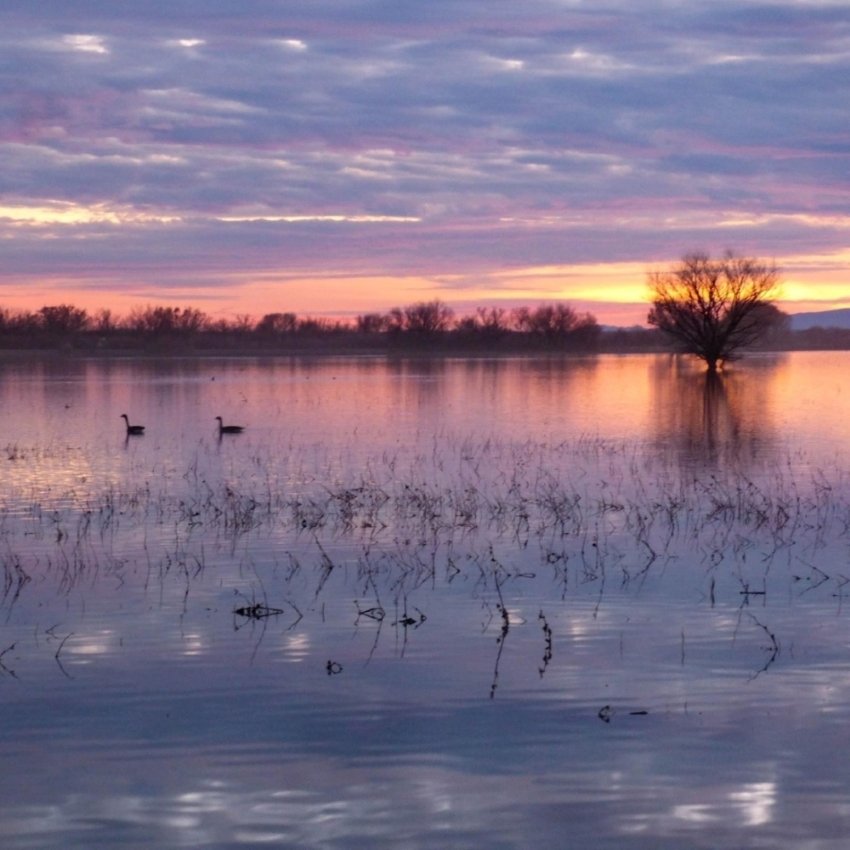
Sunrise over the Bosque del Apache wetlands | Photo by New Mexico Nomad
Many of you will recall that we celebrated World Wetlands Day earlier this year on February 2nd. This event dates back to 1971, when the Ramsar Convention was adopted (in the Iranian city of the same name) with the aim of protecting wetlands globally. It is now celebrated on the first Tuesday of February each year. This year’s promotional material summarizes today’s challenge perfectly, as it proclaims, “Wetlands: sacred, life-sustaining. A timeless legacy. Ours to protect” (Wetlands International). Sound familiar? I couldn’t have put it better myself.
And while we’re celebrating, let’s not forget World Rewilding Day on March 20th. “What’s re-wilding?”, I hear you ask. It is, “giving nature more space to lead, from wild forests and free-flowing rivers to green corners close to home. It’s about letting wildlife return, rivers shape their courses and natural processes unfold.” (Rewilding Europe).
So why are wetlands so important? The UK’s Wildfowl and Wetlands Trust says it best, “If rainforests are the lungs of the planet, then wetlands are the lifeblood. As much as we need air to breathe, we need water to live. The conservation of our wetlands is essential to life on Earth”. Specifically, wetlands are critical for biodiversity (supporting 40% of the world’s flora and fauna), carbon sequestration (much more effective than forests), flood mitigation, economic activity (attracting 50% of international tourists for relaxation and recreation), water purification (removing metals and nitrogen) and health benefits (providing relief from anxiety and stress). Alarmingly, and despite this impressive resume, wetlands are disappearing three times faster than forests globally and 25% of wetlands-dependent species face extinction!
So, why connect these two events, only a few weeks apart on the annual calendar? Well, it turns out that wetlands need animals as much as animals need wetlands! Simply put, without the presence and healthy abundance of a range of wild animal species, wetlands cannot function as we need them to.
Around the world, there are an increasing number of rewilded sites that prove this point. One I can speak of with some authority, as a founding donor, is the UK’s Heal: Rewilding, whose mission is to establish a rewilding site in each of England’s forty-eight counties. Our first site was acquired three years ago, a 460-acre abandoned farm in the Somerset Levels, much of which was drained by the Victorians and converted into farmland. In spite of the extensive drainage, the area remains notoriously prone to floods. Once we had removed the drains and filled in all the ditches, the naturally occurring water returned, and with it, a family of beavers who seemingly came out of nowhere – this year with three kits. Since then, we have re-introduced Tamworth pigs to disturb the ground, and who knows, the once common European bison may one day graze these lands again, as it did centuries ago. Three years without chemicals has led to an explosion of invertebrates and, as a result, the return of many bird species.
Closer to our home, the Albuquerque-based Rewilding Institute affirms that, “wetlands are critical for life on earth, as they provide water and play a critical role for the climate”. Yet, wetlands remain the most degraded ecosystem on the planet.
In this context, protecting Bosque del Apache becomes even more important – critical both in its own right and in a global sense.
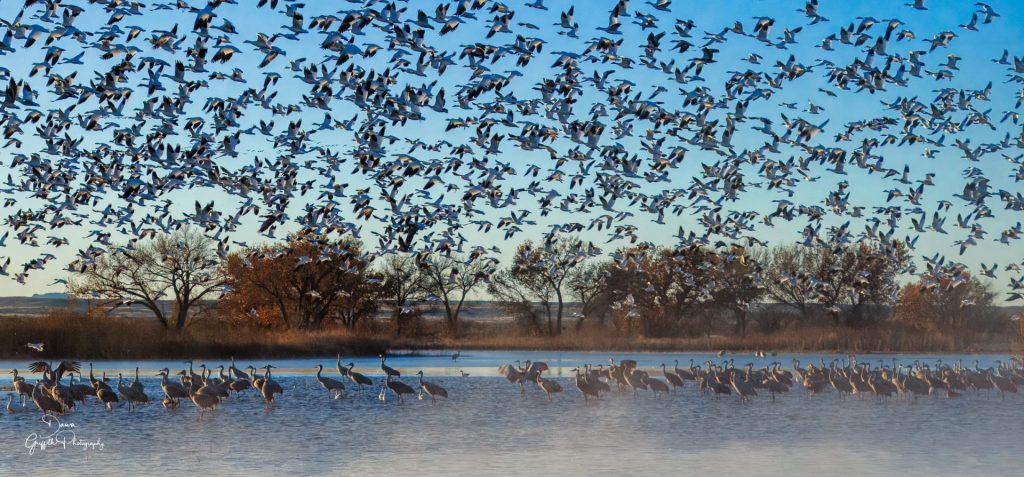
Bosque del Apache wetlands | Photo by Dawn Griffith
How do we do that as water and federal funding diminish? Should we allow nature to play more of a role in managing our 57,000+ acres, or a part thereof? Is that the only realistic option, given the continued reduction in resources and manpower? We have these and many more questions to answer, as we continue moving forward into a challenging and uncertain future. (Read on for more from Kevin Cobble, former Bosque del Apache Refuge Manager, about current hurdles the refuge is facing, as well as what you can do to help.)
Meanwhile, we’d love to see you at Bosque del Apache in the coming weeks, as we welcome spring and its iconic visitors and temporary residents. Visit us online for more information about our upcoming Spring Migration Celebration. Your support is what keeps us and the refuge going – we thank you, and please keep it coming!
At Bosque del Apache, Water is Life
By Kevin Cobble, former BdA Refuge Manager and current Friends of Bda Board Member
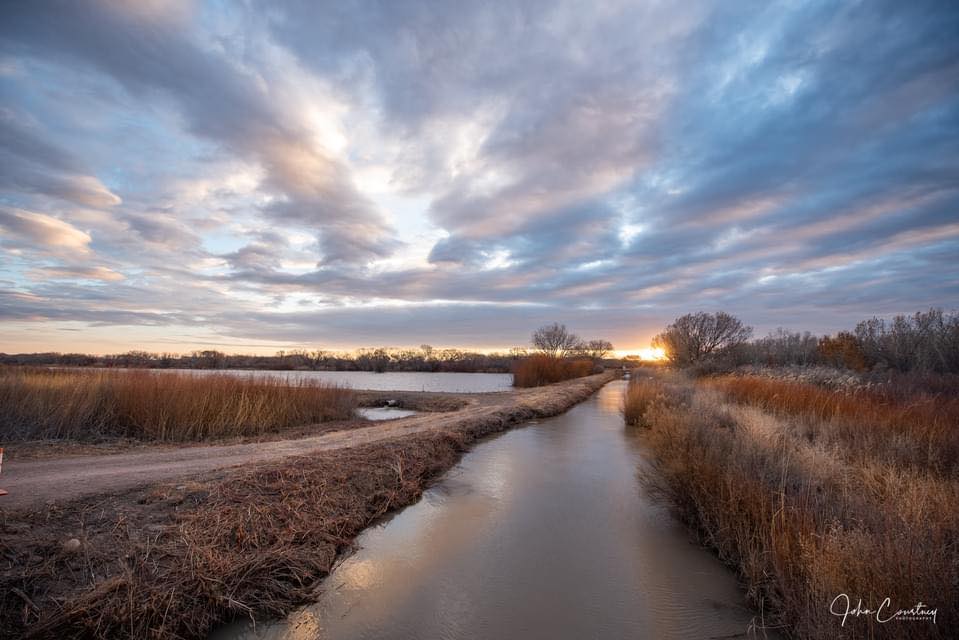
Look past the beautiful scenes of birds bobbing atop glistening water and you’ll see the reality of a parched, arid landscape. Water here has always required care, and at Bosque del Apache, a complex network of gates, channels, and culverts exists behind-the-scenes, delivering life-giving water to the refuge. | Photo by John Courtney
For millennia, there has been a rhythm to the Rio Grande through Bosque del Apache National Wildlife Refuge. As air temperatures rose in the spring, snow would melt in the mountains of northern New Mexico and southern Colorado, flowing water into the creeks and streams that feed into the tributaries of the Rio Grande. These would cause the river to rise, leading to water flooding over the banks and into the floodplain. As summer began, the river would slow and the floodplains would dry. In late summer, monsoonal moisture would flow into the valley, bringing precious rain to inundate the wetlands, filling them with water and spurring new growth. With the cooling of autumn, the cranes and geese would arrive to take advantage of the food supplies and wetlands to overwinter before heading back north for the spring and starting the cycle anew.
With the coming of European settlers, the Rio Grande has been changed to fit the needs of the human population and its normal rhythms have been interrupted. As these changes have occurred, Bosque del Apache has had to adapt. Many of the functions performed by a spring runoff and flooding are now done with considerable human effort and machinery. Natural flooding patterns are now performed using irrigation ditches and water control structures to recreate the historic patterns of flooding and drying on the wetlands within the refuge.
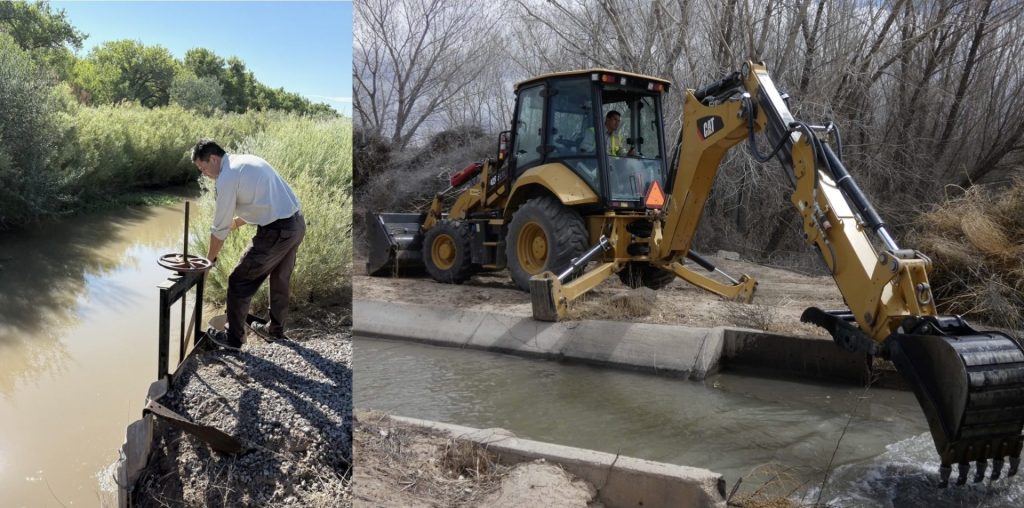
Bosque del Apache is a rare section of the Rio Grande that performs much like it did historically, though it now requires intense management to do so. Refuge staff often utilize heavy equipment to clean ditches, preventing flooding from clogged water control structures. | Photos by Stede Barber (left) and Jessica Jia (right).
Now, drought is putting additional stress on the system and the flow of water. While always a factor in the ebb and flow of water through time, climate change effects of drought are worsening. According to scientists, the last two decades have been the driest in at least 1,200 years. On top of drought, the human population continues to grow in New Mexico, making additional demands on the water supply. What can be done in a hotter, drier environment with less water available?
Refuge staff have taken measures to deal with these issues for a long time and have already been working to adapt to these changing conditions. Water flow monitors were installed many years ago to measure how much water flowed into and out of the refuge and how much water was consumed. This was done to make sure the refuge water rights were protected and as part of a larger effort throughout the Middle Rio Grande Valley to determine where and how much water was being used. Maintaining, cleaning and even lining some ditches with concrete has been an ongoing process to make sure water flows as efficiently as possible once it comes onto the refuge. Special gates called Langemann gates were installed throughout the refuge to allow better management of water levels in critical ditches and allow for less maintenance. Some of these critical gates were purchased for the refuge by Friends of Bosque del Apache.

Langemann gate at Bosque del Apache. The vertical lift and bi-fold design of a Langemann gate allows water to flow over the top, minimizing clogging of ditches with brush and debris and maintaining a constant upstream water level and consistent discharge flow rate.
Another step which staff have taken to prioritize the responsible use of water on the refuge is control of the invasive, non-native Tamarisk (salt cedar), which has been an ongoing project since the early 1990’s. Salt cedar grows into dense monotypic stands and uses a tremendous amount of water during the year. Refuge staff have cleared well over 4,000 acres of monotypic salt cedar and replaced it with native vegetation, which uses much less water and is more beneficial to native wildlife. The refuge estimates that removal of salt cedar has resulted in water savings to the refuge of well over 6,000 acre feet a year.
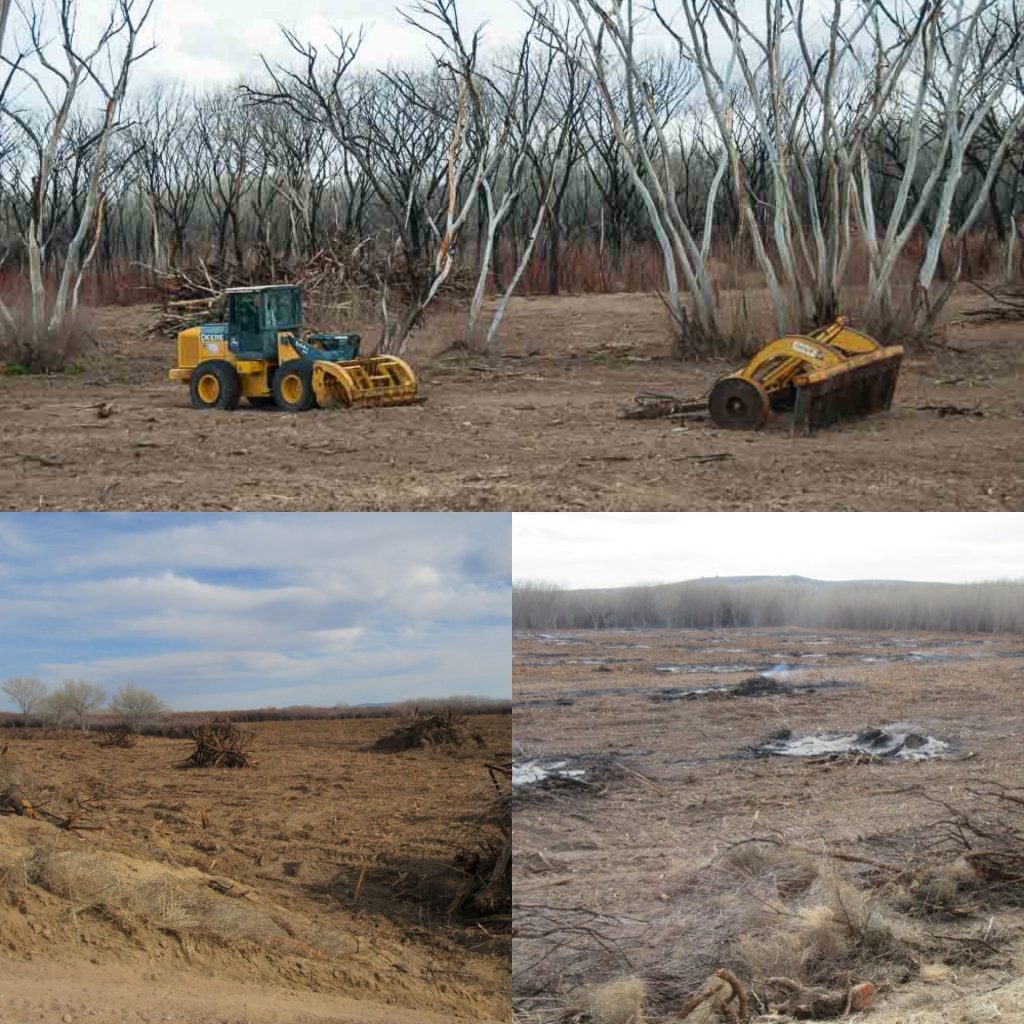
Salt Cedar removal on the refuge is a tremendously labor intensive process, involving plant removal using heavy equipment, piling of brush, allowing a period for drying, and then eventually burning those brush piles through prescribed burns. | Photos by Catherine Sandell
As water supplies have continued to become tighter due to drought, the refuge has had to make many tough choices. One of those was the decision to reduce and eventually eliminate farming of crops on the refuge. Many of the justifications for a large farming program were no longer valid with the changing climate. Water was prioritized for wetland food production and water for Endangered species, such as the New Mexico Meadow Jumping Mouse, Southwestern Willow Flycatcher and Yellow-billed Cuckoo. Reduction in surface water flow has even led to more frequent use of groundwater from wells, but electricity costs and potential for stress on the water table make this a short-term remedy.
The refuge has also participated in long-term drought planning to try and adapt rapidly to changing conditions and water availability. Based on spring runoff predictions, refuge biologists will plan for which wetlands can be managed to grow food for the next fall. Wetland units will be added or subtracted as conditions change. The goal is to be able to produce at least 2 million pounds of natural food in the wetlands in any given year, but 2025 was an especially dry year, and there was no water available at all during the month of July. This water shortage resulted in the refuge producing only about 1.4 million pounds of natural foods – one of the lowest yields in recent years. Unfortunately, the outlook for 2026 is not projected to be much better.
Other factors affecting how the refuge manages water and food production for cranes and waterfowl, which are not mentioned enough, are increasingly insufficient funding and personnel to carry out this work. Federal funding for the National Wildlife Refuge System peaked in 2012 and has been on a steady decline ever since. Bosque del Apache has gone from over $2.2 million in federal funding in 2018 to about $1.4 million in 2025. Refuge staffing has gone from about 20 full-time staff, including a Fire Crew, to 11 in 2025. Without adequate funding and personnel, the ability to continue adapting to changing climate conditions and maintaining what is already in place becomes immeasurably harder.
This (im)perfect storm of diminished funding, staffing, resources and water will certainly force the refuge to innovate further to overcome these obstacles and continue providing quality habitat for migrating and resident wildlife and the visiting public alike. Now is the time to turn our attention to what we can all do to help.
Bosque del Apache needs your support now more than ever!
This year, we’re proactively preparing to rebuild the refuge lifelines, preventing failures before parts of the vital Bosque del Apache wetlands are at even further risk. Friends is aiming to raise enough funds to assist with the repair and/or replacement of aging but critically important water control infrastructure on the refuge, and we need your help! Your donations will help the refuge make needed repairs and upgrades now — ensuring water continues to reach essential habitat uninterrupted. (Visit our website for more information on this important project.)
And there’s great news… a generous foundation has stepped forward with a matching grant, which means that every dollar you give today will go even farther towards meeting this important goal.
Our fundraising goals for this year include raising:
- $75,000 by April 1 (to acquire a $25K foundation match)
- $125,000 by December 1 (to complete the 1st phase of necessary upgrades)