
By Karen Haley, Friends Member
It is late October in Wisconsin, the Amish are harvesting corn from their fields in their labor intensive way, and as the fields become stretches of corn stock nubs, the cranes move in as gleaners—cleaners picking up bits of dropped corn kernels. They are laying on their fat stores for the long migration south to warmer weather and less hostile places there in the bosque by the Rio Grande. One can only marvel at the feat of accomplishment it is… this hauling of ungainly bodies and long, thin legs through the air for mile, after mile, after mile. Their powerful silent wingbeats and uncanny navigation instincts are the tools they have evolved over time, but the first-year colts must keep up the pace or perish. No wonder they fly in flocks… such a daunting task they set for themselves!
It’s ironic that the middle of our nation is called “fly-over country” by the people living on both coasts, because that is precisely what it is for the cranes. They follow what are known as ‘fly-ways’ that take them from north to south across the mid-section of the United States to their wintering grounds, like Bosque del Apache. Then in the spring, they do the reverse, retracing their path back to their breeding grounds in the north.
For those of us who live in fly-over country , this is our chance to experience the wonder of cranes. Witnessed either flying overhead or in the wetlands they use along their way to rest and feed, they are a welcome sign of fall (or spring) for us. We try, in our own way, to help support the cranes, by advocating for preservation of important wetlands along the migration paths, agitating against pesticides, even trying to understand and work with the farmers whose fields are targeted by the cranes for feeding forays.

Sandhills sometimes preen iron-rich mud into their feathers, staining them rusty brown until they molt in the fall.
The International Crane Foundation in Baraboo, Wisconsin, an important partner to Friends of Bosque del Apache, is a strong presence in the Midwest for this conservation work, but they are buttressed by hundreds of small local nature centers that quietly work one-on-one with the people in their respective communities. They foster awareness, and even more importantly, appreciation for these wonderful birds, especially among the school children who will grow up to be the next stewards of the diversity we are working so hard to maintain for them.
So, listening for the autumn calls of the cranes is just as much a part of fall’s appeal as the glorious reds and yellows of the hardwoods in our forests (and front yards), here in flyover country. We can smile knowing the migrants have a refuge like Bosque del Apache at the end of their long flight.
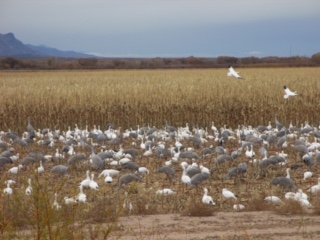
Sandhill cranes and snow geese enjoying the Bosque del Apache farm fields.