
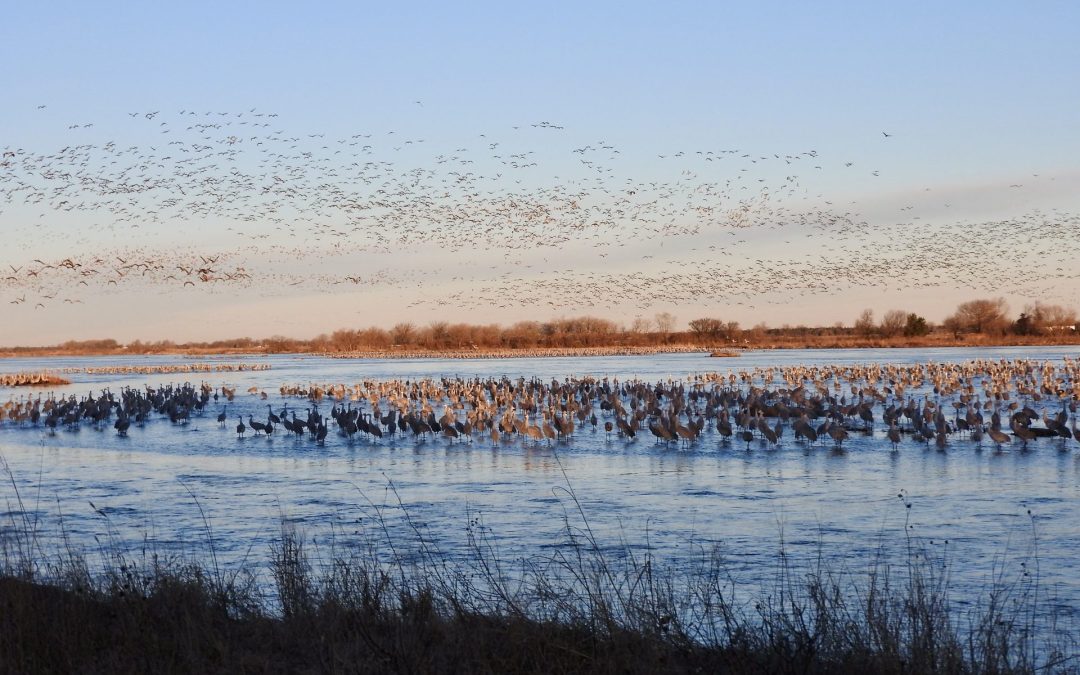
Some of the million Sandhills that stage along the Platt River in central Nebraska. Photo by Sandra Noll.
Article by Keanna Leonard, crane expert and long-time presenter at Festival of the Cranes.
I live in Nebraska along the central Platte River where around a million Sandhill cranes visit each spring before pushing on north to their nesting grounds. In fact, the Platte River hosts the largest gathering of cranes in the world every spring. It is an incredible wildlife experience indeed!
Yet for over twenty years I traveled to Bosque del Apache National Wildlife Refuge in late November or early December to see cranes and conduct crane behavior workshops at the Festive of the Cranes. Each and every year people would ask why I traveled so far. The question is quite easy to answer.
First of all, I, along with my mentor and friend Paul Tebbel, love conducting the workshops. The workshops are designed to open a whole new world of appreciation and understanding of the cranes. It is rewarding to watch our participants connect to these wild creatures.
But you are probably still wondering why travel to New Mexico when we have so many cranes that come through Nebraska. Crane behavior, especially individual behavior, is much easier to observe and point out to workshop participants on the crane’s wintering grounds, like the refuge, where there are fewer cranes.
Also when cranes reach their wintering grounds in the fall, they are tired and hungry after the long trek from their northern nesting grounds. They seem ready for some “R and R” and pay little attention to people. We can stand out on the low dikes at the refuge with cranes no more than twenty yards away and cause little disturbance.
If you tried to do that along the Platte River during spring migration, the cranes would startle easily. The response is most likely due to the pressures of migration. The best way to observe them here in Nebraska is to sign up for viewing blind tours at the local nature centers.
But my biggest motivator for driving down for so many years has been that Bosque del Apache National Wildlife Refuge and the Platte River are connected.
How you ask? Eighty percent of the world’s population of Sandhill cranes stop in the central Platte River valley each spring. That includes many of the same birds wintering on and around the refuge. Both areas are part of the bird migration route called the Central Flyway and each area has similar conservation goals. The local, state and federal conservation organizations work to conserve the ecosystems that are crucial for Sandhill cranes and other wildlife through their management practices and educational efforts. By connecting the work done along the Platte River with partners up and down the Central Flyway like the refuge, we are not only creating a connected conservation network for cranes, but for all birds.
You and I are also connected through our resolve to protect and conserve our natural resources and our love of cranes. This truly is a gift that keeps on giving.
I encourage you all to not only enjoy cranes on their wintering grounds while attending the Festival of the Cranes, but to also consider migrating with them this spring to the Platte River and witness the mass migration. You will not be disappointed.