
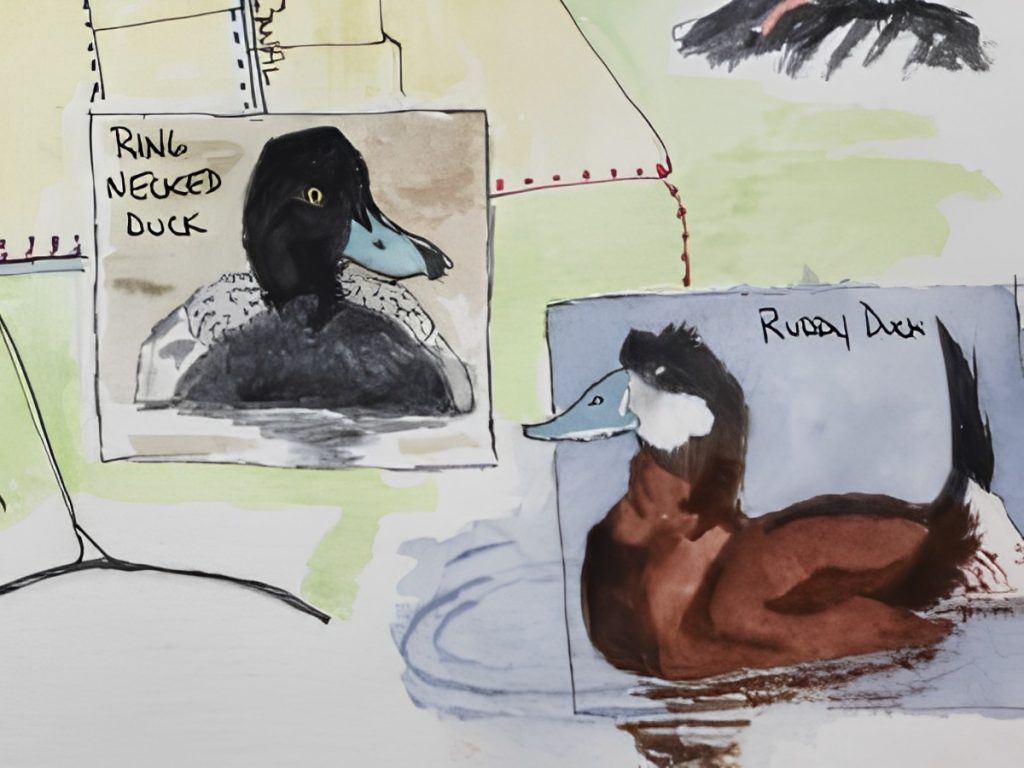
Article and journal photos by Cindy Robbins and Nancy Meyers
Nature journaling is the practice of recording or expressing one’s experience and observations in nature in a way that is personally meaningful. There are many ways to nature journal – as many ways as there are journalers. Some people emphasize artistic expression. Some compose prose or poetry. Others keep something like a field journal, recording more scientific observations. All nature journalers spend quiet time observing nature and then express their experience and preserve their observations in a permanent record. You don’t have to be an artist, scientist, or naturalist, but almost all journalers use some kind of pictures, words, or numbers to document their observations, such as sketches, poetry, scientific notes and measurements, maps, diagrams, personal reflections, color, and meta-data referencing the conditions of the day and the place observed. The key to keeping a nature journal is finding a practice that is meaningful to you.
Nancy and I (Cindy) became close friends while working together and sharing an office for more than a decade at New Mexico State University in Las Cruces. When Nancy moved to Albuquerque, we decided to meet one day at Bosque del Apache NWR, conveniently located about halfway between Las Cruces and Albuquerque. As we were both learning to nature journal, on that day we packed our art supplies and a brown bag lunch and spent the day observing, sketching and taking notes, and reveling in the beauty of the refuge. After that, we pledged to spend at least one day every month nature journaling together at Bosque del Apache.
The Bosque is a magical place to us and, with its diverse habitats, wildlife, and plant life, it is the perfect place to observe nature up close. We each have our own approach to nature journaling, but now with a full cycle of seasons of observations, our journals have become special documents of our friendship and of the refuge that we love.
We begin each visit with a stop at the Visitor Center to stamp our journals with the official date stamp for Bosque del Apache, and to check the lists of observations recorded by those who have visited before us. Then, entering the refuge, we choose a pull out or trail to find a place to sit quietly to observe. We do drive the loop roads sometimes to get a general idea of the wild happenings in the refuge, but rather than chasing a particular bird or animal, we find a spot to sit in stillness and allow nature to come to us. A theme for the visit often arises from the things we see in multiples – “It’s sunflower day,” or “It’s turtle day,” or “It’s raptor day.” We now have a little more than a year of monthly visits in our journals, but we have only begun to fully capture its beauty, wonder, and mystery. Our friendship grows, as does our knowledge, understanding and love of the Bosque.
CINDY’S NATURE JOURNAL
I was introduced to nature journaling in 2020 as a participant in a nature journaling conference hosted by the Wild Wonder Foundation. I was interested immediately and began taking more online journaling courses and workshops to hone my skills. Over time, I have adopted a practice and style that works for me; a practice that combines sketching nature as well as capturing the artifacts left by human presence and my sensory experiences. I am trying to capture a sense of place as I make drawings and notes about the plants and animals and landscape I am observing.
On our first visit to Bosque del Apache, we spent some time at the Boardwalk and I began my journal pages with some quick sketches of the cattails and wading birds. I have a little routine for beginning my journal pages. I sit and take a photo of the scene directly in front of me to capture the context for my observations that day. I record the meta-data – date, time, place, weather conditions, and who I may be with that day. I look up at the sky and take note of the clouds (if any!) and make a small sketch – often a simple clear blue rectangle in New Mexico! I tune into each of my senses and make note of what I see, hear, smell, feel, and taste. I sketch a very small landscape of the scene in front of me and note the colors around me in their proportions on a little color wheel. I may take lots of photos – particularly if there is animal or bird presence. I draw slowly and so I use these photos at home to complete my journal pages as well as assist with identification using apps.
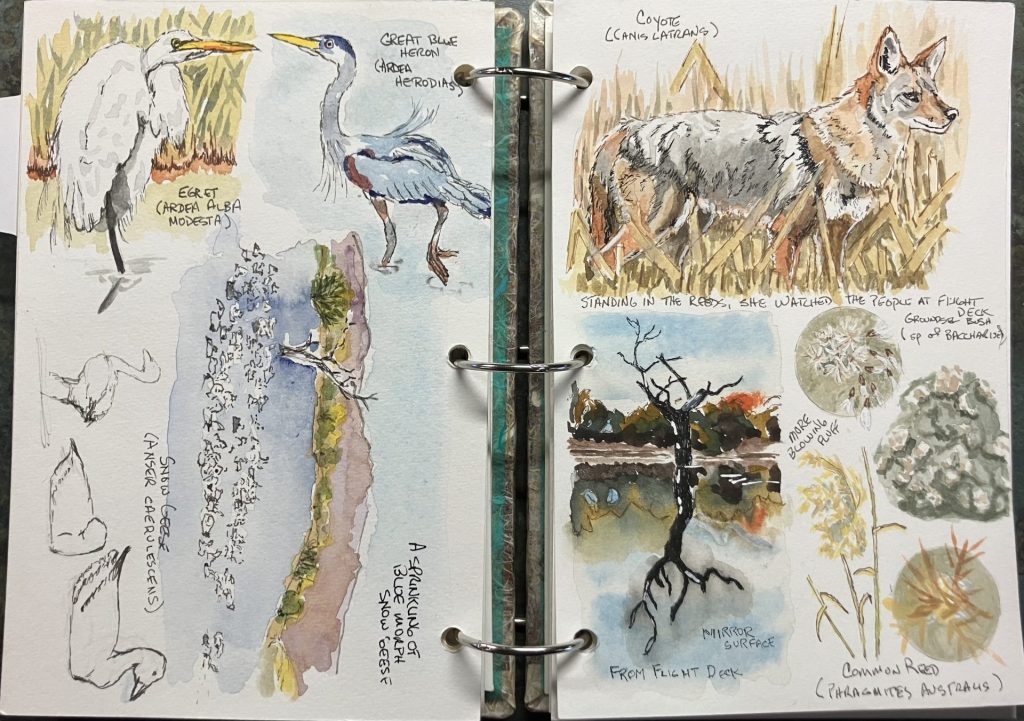
We moved to the Flight Deck where a coyote stood at the edge of the high grass and watched all the visitors milling about the edge of the pond. I took a photo of the coyote and completed the drawing at home, having left some space for it on the page. The eagle snag reflected perfectly on the mirror surface of the pond and I sat and sketched it. I remember this day so very clearly because of my journaling; much more so than I would from the photos I took.
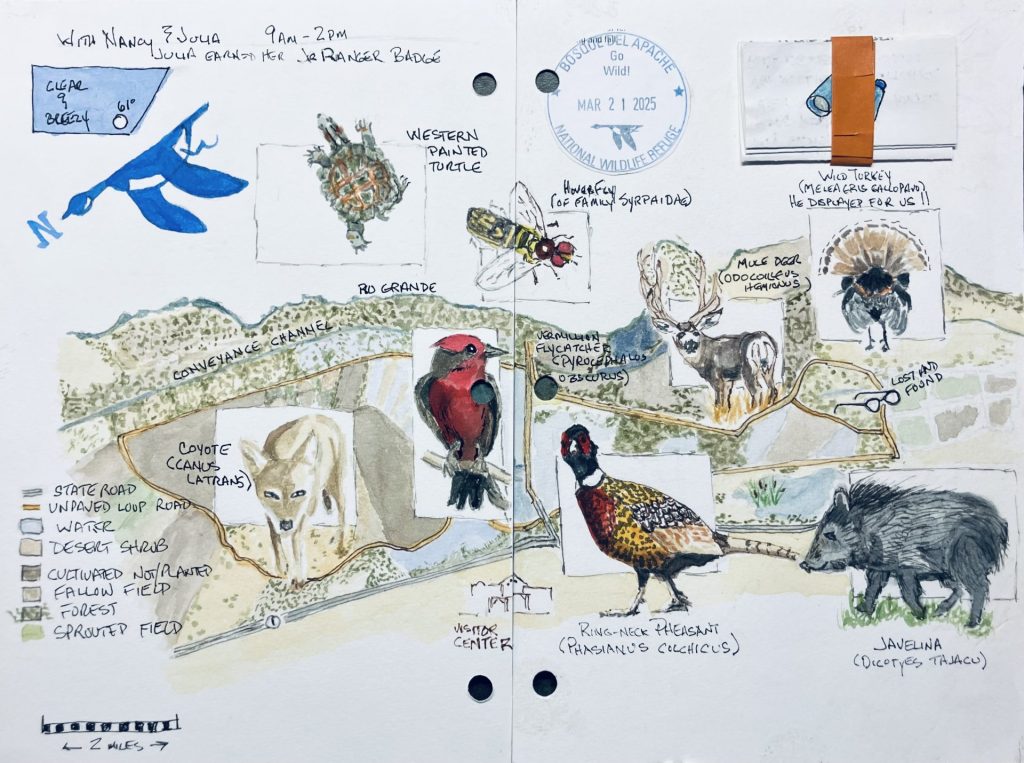
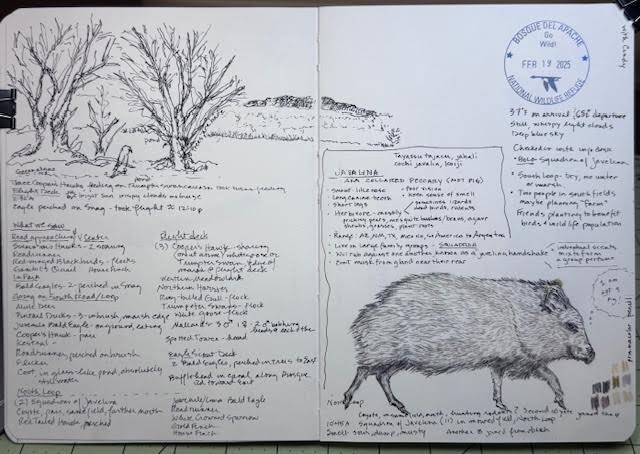
We saw so many birds and animals on that visit in March 2025. I did some quick sketches on location and then later decided to plot some of my sightings on a map of the refuge. I used Google Earth as a reference to lightly sketch in the map and then I placed some of my sightings near the location at which they were spotted. Note the “Lost and Found” on the South Loop – I was getting accustomed to using a new pair of binoculars and dropped my eyeglasses in the process. I didn’t notice I didn’t have them until we were at the farthest point of the North Loop and so Nancy, our driver for the day, was gracious enough to retrace our stops until I found them! I recorded that spot on the map as well. It’s nice to add something personal or humorous to a page to add to the unique experience of the day.
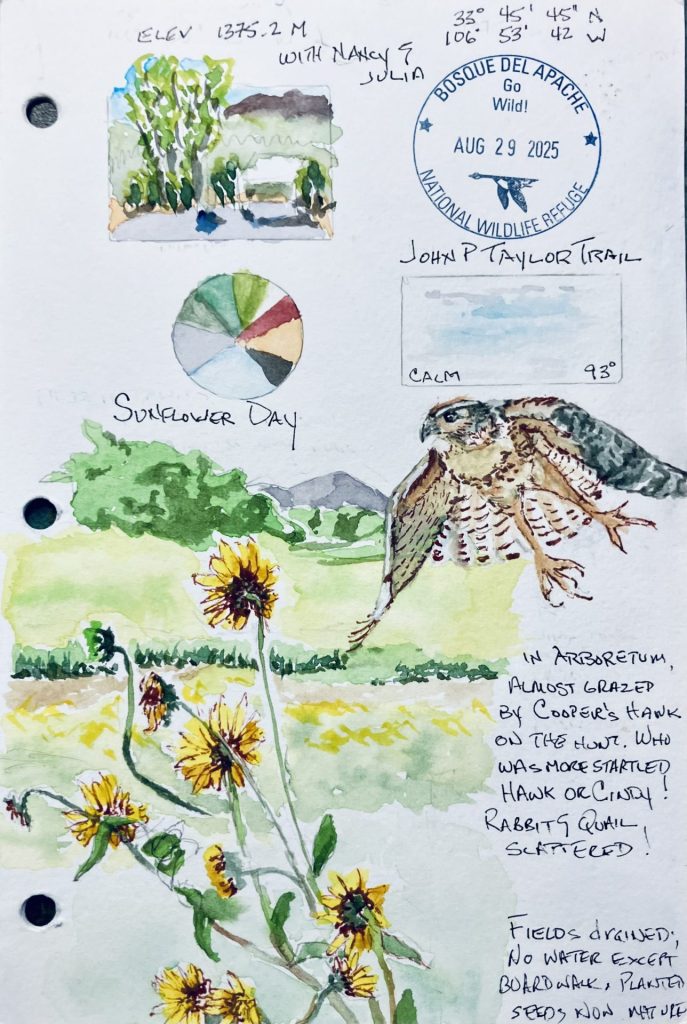
There are not many rules in nature journaling – just a record of a live experience in nature that was at least started on site. “Nature” can be a national wildlife refuge or your own backyard; a squadron of javelina or the over-ripe peach in your refrigerator drawer. Sketching the sunflowers in August was easy-ish to do on site, but the Cooper’s Hawk startled me, dove so fast and so close there would be no way to even photograph him, so I added a drawing at home from an open source photo reference I found online. I just couldn’t leave the moment out of my journal!
NANCY’S NATURE JOURNAL
Nature journaling for me combines the best of two worlds: my love of being outdoors in nature and my passion for art. Cindy introduced me to nature journaling during visits to beautiful locations like the Mesilla Valley Bosque State Park and Dripping Springs Natural Area in the Las Cruces area, and the Randall Davey Audubon Center and Sanctuary in Santa Fe. I find nature journaling to be a meditative experience that enhances my awareness in nature and allows me a very personal way to enjoy the natural world, quietly observing and slowly recording my observations and thoughts. (Emphasis on slow!) While it is my goal to complete a page in one sitting, I rarely accomplish that while on location. What I do try to do is gather enough information and do some initial drawings to establish the layout for my journal pages, then finish the pages at home using my photo references from the day. Commitment to monthly visits to Bosque del Apache has given me a way to observe and record seasonal changes. Every month at the Bosque is familiar but a bit different, and I try to capture some detail of the change in my journal.
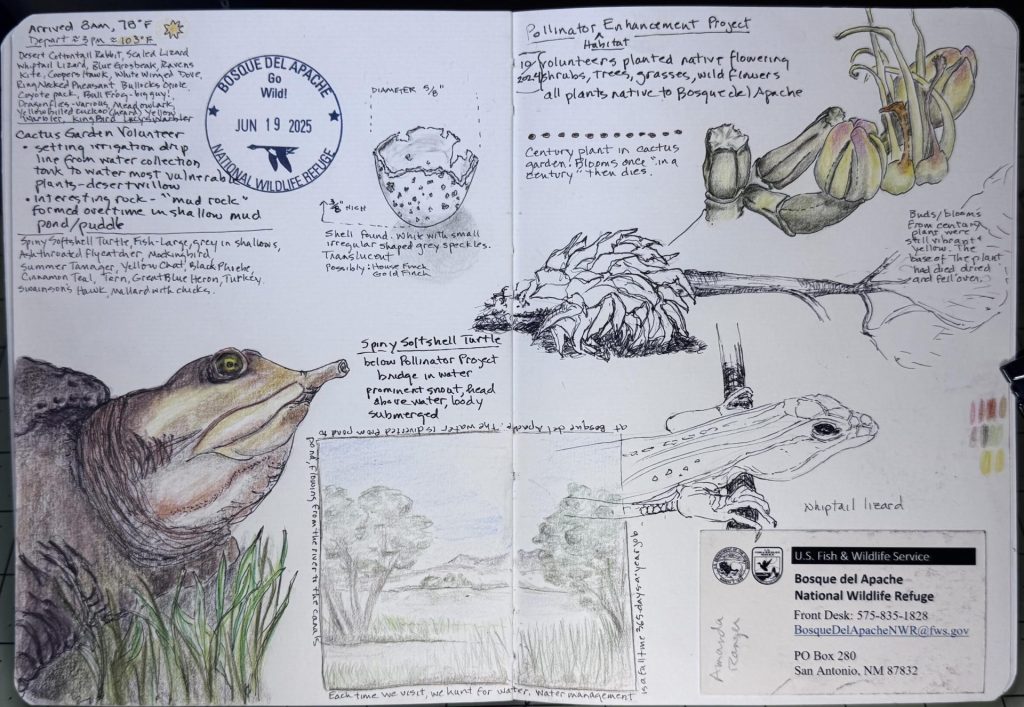
Driving through Bosque del Apache is beautiful and enjoyable, but sitting or slowing down offers its own surprises. In June 2025, as always, I listed the variety of birds and other wildlife we observe during our monthly visit. This particular day, I sketched a Spiny Softshell Turtle that appeared below a bridge over a water canal and a Whiptail Lizard that struck a pose on some dried vegetation. We found a broken shell that, by its appearance and size, we guessed may have been from a bird in the finch family.
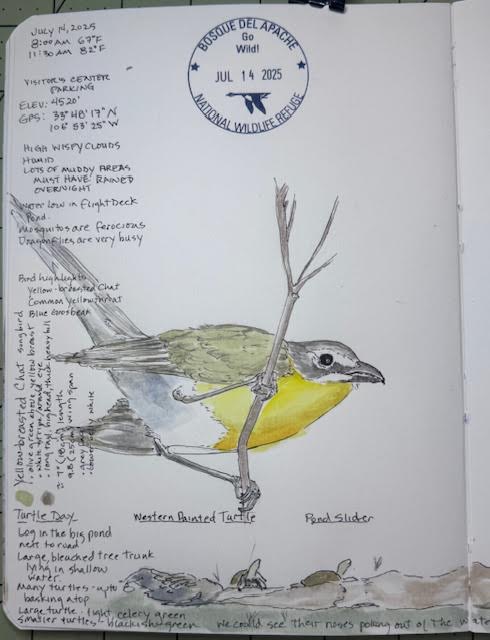
In July 2025, I captured a Yellow-breasted Chat flitting about in some brush. As the ponds were draining, we were lucky to observe many turtles in low ponding areas, trying to catch the sunshine. These two were perched on a log west of the Flight Deck.
It is always exciting to see a squadron of Javelina, also known as the Collared Peccary. They are amusing to watch out in the fields, scrambling along the ditches and foraging out in the fields. Learning about the birds, animals and plants at Bosque del Apache has been an enriching experience. My two favorite resources to help with identification are Sibley’s Field Guide to Birds of the West and A Field Guide to the Plants and Animals of the Middle Rio Grande Bosque, both of which are always close at hand.
The benefits of spending time in nature are well known – improved mental, physical, and cognitive health. Among other things, being in nature reduces stress and anxiety, boosts immune systems, encourages physical exercise, and improves a sense of well-being. Nature journaling enhances these benefits and improves brain health by requiring focus, concentration, and close observation. Nature journaling is a reverent way of appreciating the natural world – plus, it’s fun!
If you are interested in learning more about nature journaling, join Nancy and Cindy at Spring Migration Celebration. They will be offering two different workshops (9am and 1pm on Thursday, April 30, 2026) to share more information about and techniques for nature journaling. No experience required! Don’t miss out – registration is now open, and we can’t wait to see you there!
Cindy and Nancy would like to thank the staff, volunteers, and Friends of Bosque del Apache for their kindness, helpfulness, and for the excellent work they do maintaining the refuge for us and others. Thank you so much!!