
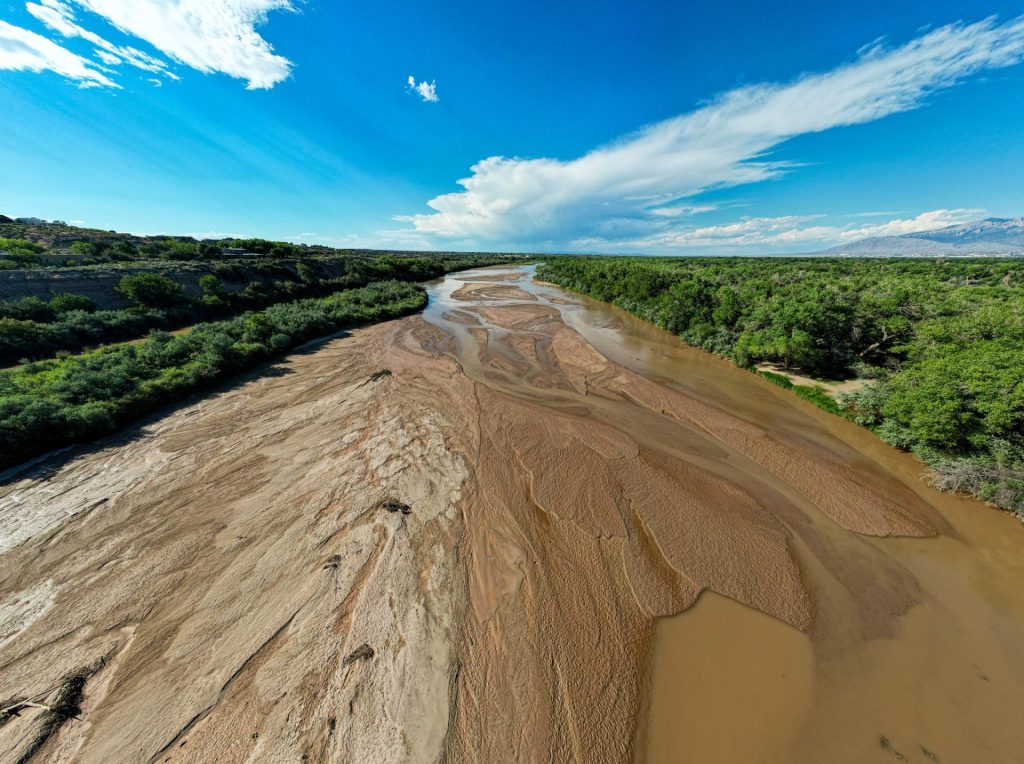
The Rio Grande River is often dry for much of the year in southern New Mexico, but is allowed to run during irrigation season.
Article and photo by Paul Tashjian, Director of Freshwater Consumption at Audubon Southwest
It is often said that water is the life blood of our rivers and in our moisture-deprived state these words resound. The timing and endurance of flows in our rivers drives the life cycles of the myriad of species that evolved along our ribbons of life. From the Sandhill Crane to the Rio Grande Silvery Minnow to the Southwestern Willow Flycatcher, the flows in our rivers at the right time, place, and amount ensure survival.
Water in the West is managed for both public and private benefit. Any individual or entity wanting to use water must have a legal right to do so—a “water right.” These water rights were obtained from the state over the last century in a priority system and traditionally only granted to irrigators, cities and industries, with no guarantee that environmental flows would be maintained. At least that was the case until 2020 when Audubon and Trout Unlimited were awarded the first-ever in-stream-flow permits for a State-based, privately owned water right. These permits represent a historic step forward for New Mexican rivers and now allow private water right holders the option to lease or sell their water for environmental purposes. This is a big deal because many rivers in New Mexico are over-allocated—there are more water rights on paper than actual “wet” water in the rivers- and as droughts become more frequent there is a need to ensure that our river courses remain vibrant. Prior to these permits, private water right holders did not have the option to use their water for the protection of stream flow and now that they do, both the water right holder and the ecology of the river system will benefit greatly.
While New Mexico has been one of the last western states to approve of this type of water right, we can boast about having developed other creative mechanisms for enhancing river flows, including the New Mexico Strategic Reserve and the leasing of San Juan Chama water.
The New Mexico Strategic Water Reserve was established in 2005. The Reserve allows for the state of New Mexico to purchase or lease water rights to use for addressing endangered species and interstate compact water needs. The Reserve was largely used on the Pecos River through 2007, with annual budgets ranging from $500 thousand to $2.8 million, with some minor transactions in later years on the Rio Grande. During the 2020 and 2022 New Mexico Legislative sessions, a coalition of non-profits successfully lobbied for a $750 thousand revitalization of the Reserve, followed by a robust appropriation of $7.5 million dollars in 2023.
Another important mechanism that has been used for maintaining stream flows on the Rio Grande in New Mexico has been the leasing of San Juan Chama water. In case you haven’t heard of this “Cadillac Desert” engineering feat, San Juan Chama watershed water is diverted from the Colorado River’s San Juan River into the Chama River’s Heron Reservoir using a series of pumps, pipes and ditches completed in 1976 by the federal government. The original intent of the project was to provide unallocated Colorado River water to central New Mexican cities, however some water from the project has been available for leasing for other purposes. San Juan Chama water is federally managed (not by New Mexico) and because of this, has greater flexibility for in-stream flows, especially when meeting endangered species needs. The US Bureau of Reclamation has leased large blocks of this water since 1997 for ensuring the survival of the Rio Grande Silvery Minnow. Audubon Southwest has been the sole non-governmental organization that has been leasing San Juan Chama water for environmental purposes. Since Audubon’s initial transactions in 2016, we continue to provide water at critical times to the Rio Grande, using leased San Juan Chama water.
New Mexico desperately needs an environmental flow program that utilizes all available tools and funding sources for protecting our rivers. Back in the day, such programs were referred to as “in-stream flow” programs and were stigmatized as a direct threat to traditional water uses. Where environmental flows have been implemented in the state for Endangered Species Act compliance, the fish vs. farmer dichotomy has largely been proven false. From the Pecos River in central New Mexico, to the Middle Rio Grande, environmental flow programs appear to only help rivers and the people that rely on them. Environmental flows are largely non-consumptive and provide water that would not be there otherwise, which can be used for more “traditional”, consumptive uses downstream, like farming. Environmental water leasing programs have provided funding to farmers for taking a year off during drought and improving their irrigation systems. Reservoir management changes have returned the timing of key hydro-ecologic cues to rivers with little to no water costs, and any of these costs are compensated. These types of solutions may be a bit “out there”, but the problems at hand are often elusive and demand creativity and commitment from all parties: our rivers demand a state-based environmental flow program.
For more information or to get involved and offer your input, check out groups like Main Stream New Mexico and New Mexico Interstate Stream Commission, which are currently taking steps to plan for and secure New Mexico’s water future through the Water Security Planning Act.