
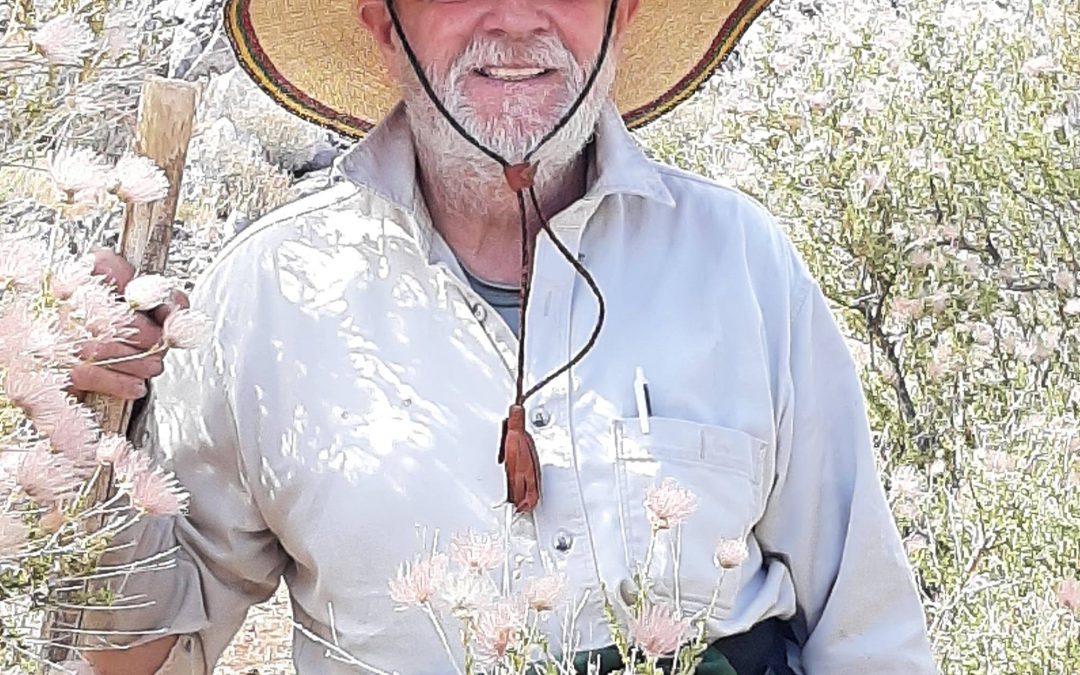
Reflections by Daniel’s friend, Robyn Harrison:
I remember first meeting Daniel in the spring of 2000 when he led a hike up Chupadera Peak. By then Daniel had been working in Visitor Services at Bosque del Apache NWR for ten years. The trail had just been completed by a contingent of Youth Conservation Corps workers with Daniel’s guidance.
I remember Daniel’s extraordinary rapport with the refuge volunteers. Many of them returned to Bosque year after year. They loved the refuge, of course, but I think even more, they appreciated working with Daniel. When things got really busy at Festival, Daniel would be in there right along beside them scrubbing toilets and emptying garbage cans.
Daniel could identify birds by their feathers, their songs, their nests. Latin names of plants rolled off his tongue effortlessly. A hike meant a ramble, an exploration, a saunter. He collected friends as easily as he collected plants.
His greatest legacy to the refuge is the Desert Arboretum, which he and his partner Socorro helped build. At the time, they lived in what is now the Friends house. What started off as a rough yard turned first into piles of rubble and then, slowly, into an oasis visited by wildlife and humans alike.
Though he retired more than a decade ago, he was still a familiar face at Bosque del Apache. With binoculars in hand, he’d show visitors around the observation decks, or he’d pick up a rake or a shovel during a volunteer workday at the pollinator site.
I miss his expertise and good cheer but feel privileged to have known and worked with him, as both a colleague and a friend.
Reflections by Daniel’s friend, Tom Hyden:
I first met Daniel Perry when I was searching for information on how to grow cold-hardy vegetables in the winter in New Mexico. I had been experimenting with various covered beds in the backyard of our Socorro home. I heard that Daniel had greenhouses and so I went to visit him. I quickly discovered a kindred spirit in the world of growing plants. He showed me his first greenhouse (PVC hoophouse) and his second, third and fourth greenhouse. Of course, they were all filled with cactus. About 30,000 cacti. Daniel, as you will see, liked to do things in a big way. All those cacti were for the business that he and Socorro had started, supplying plants to nurseries in Albuquerque, El Paso and the numerous plant shows that he and Socorro attended.
He and Socorro traveled every winter, usually to Mexico but sometimes farther afield, even as far as Ecuador. Socorro is the adventurous one while Daniel preferred to sit in a coffeehouse, sip on a cup and read a newspaper. Meanwhile back at the ranch, Robyn and I were watering those thirsty cacti.
As my gardening business grew, Daniel told me that he hated me because I could grow tomatoes and he couldn’t. It wasn’t for lack of skill but rather a quirk of geography. Daniel and Socorro’s land was not in the valley proper but up about 50 feet above our farm. That meant that he had no soil to speak of. I told him that the price for our good soil was bindweed, kochia and Johnsongrass and that I would sell him all the tomatoes that he wanted.
The plant shows, in Oklahoma City, Dallas, Denver and El Paso, were hard work but financially rewarding. Eventually, lifting 130-pound flats of cacti seven or eight times for each show stopped being fun, and he and Socorro retired from the cacti business. Was Daniel done growing plants? Of course not. I had several orchids, and I tried putting them in a terrarium to preserve moisture and humidity. Daniel saw that, and a week later he had two aquariums full of orchids. Two weeks later he had ten aquariums. Then he started filling the solarium (the greenhouse attached to their house). He was growing orchid offsets and mature orchids but he decided that he wanted to try to develop a unique variety. (Historical note: as a young man in West Virginia, Daniel grew and sold orchids commercially.) I stopped counting at 5000. Now when he and Socorro traveled and had coffee, Robyn and I watered the orchids and the cacti. Unfortunately, the orchids developed a virus infection and had to be destroyed. Undeterred, Daniel went on to his next project.
Milkweed. This phase coincided with the beginning of the Pollinator Project at the Bosque del Apache and me talking a lot about milkweed and Monarch butterflies. There is a farm field about halfway between our house and Daniel’s that was full of milkweed. We used to meet there about once a week and do an informal walking count of adult Monarchs and larva. He began to grow native milkweed species and at least one non-native species and give them to his friends.
His last project was figs. He collected fig cuttings from all over Socorro and rooted them and gave them away.
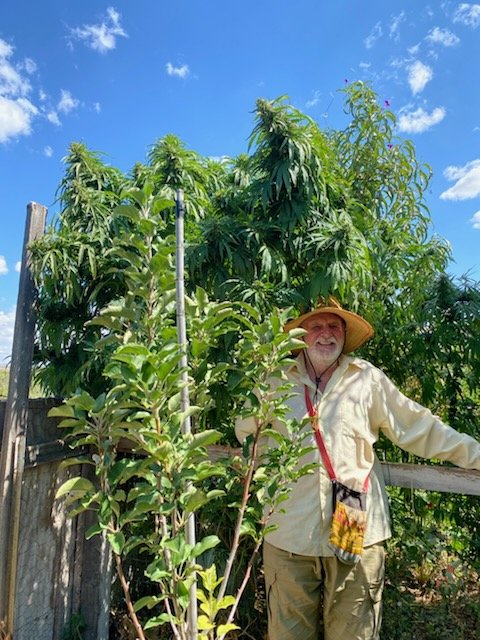
Photo provided by Susan Oviat | Daniel with her fig.
Daniel was a quiet man who had a large influence on those around him. He was always available to help prune a tree, take a friend to a medical appointment or cat-sit, which he did for us often. He said that he hated cats but our little Boomer and Frankie became his cat friends. I will miss him and be reminded of him every time I water our fig tree, see a Monarch butterfly or admire my orchids when they bloom.