
Michael Engelhard is the author of Arctic Traverse: A Thousand-Mile Summer of Trekking the Brooks Range, from which this essay was excerpted.
It is spring. Bound for the coastal plain south of the Arctic Ocean’s Beaufort Sea, a sandhill crane and her “siege” approach the Arctic National Wildlife Refuge in Alaska – North America’s last best place. Established in 1960, slightly smaller than Austria, it’s the stage for cycles lately wobbling, out of sync, yet mainly unfolding as they did at the end of the Pleistocene. Nomadic hunters, likely from the lower Amur River, 14 to 20 millennia ago drifted south into Patagonia after crossing Beringia, a continent-size land now 160 feet underwater. In search of elusive game, they tried to adapt to a new, warming world.
We will have to as well, as a nation and as a species.
Obeying an ancient urge, the cranes, after rallying loudly, vacated wintering roosts in New Mexico’s Bosque del Apache National Wildlife Refuge weeks before. They mostly travel by day, in family groups, weather permitting, using landmarks as beacons, soaring much of the way, riding thermal elevators, gaining altitude whenever possible, rationing fat reserves and their strength.

A pair of sandhill cranes takes off from the Creamer’s Field Migratory Waterfowl Refuge in Fairbanks during the fall Sandhill Crane Festival. Photo by Daniel Glenn.
They skein past Arctic Village, a Gwich’in Native village at the refuge’s southern limit, and all villagers sense a season turning once again. The Porcupine caribou herd has already left this vicinity for its calving grounds on the coastal plain after sacrificing a few of their kind so that the Gwich’in may survive.
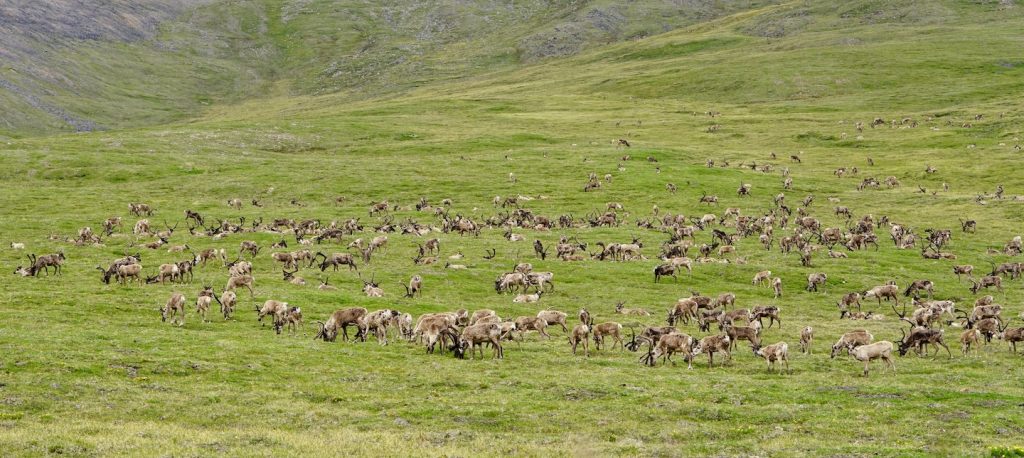
Part of the Porcupine caribou herd during its aggregation in the Arctic National Wildlife Refuge. Photo by Danielle Brigida, USFWS.
Sloughs and lakes, serpentine creeks, slate ridges, debris fans, and broad glacial valleys profile terrain difficult to explore on foot, especially during breakup when streams shed their carapaces and snowmelt saturates tundra. Near the head of the Chandalar River’s East Fork, where knolls escalate into massifs and spruces increasingly dwarf, the boreal forest thins, a spent army actually advancing. Rising to meet what could be mirages, the cranes bunch together with hoarse, rattling calls. Gar-r-r-r-o-o-o. Gar-r-r-r-o-o-o. Primaries splayed fingerlike push air for extra lift. Scores of bills point pole-ward, unwavering compass needles. With age, cranes become better navigators, setting straighter courses, cutting miles, saving calories. Their skills improve with practice, but young birds also learn from their elders, an example of culture transmission. Even without veteran fliers, however, first-timers unfailingly launch directed by genes as spring alights. “Their annual return is the ticking of the geologic clock,” Aldo Leopold wrote about sandhills. And: “Upon the place of their return they confer a peculiar distinction.”
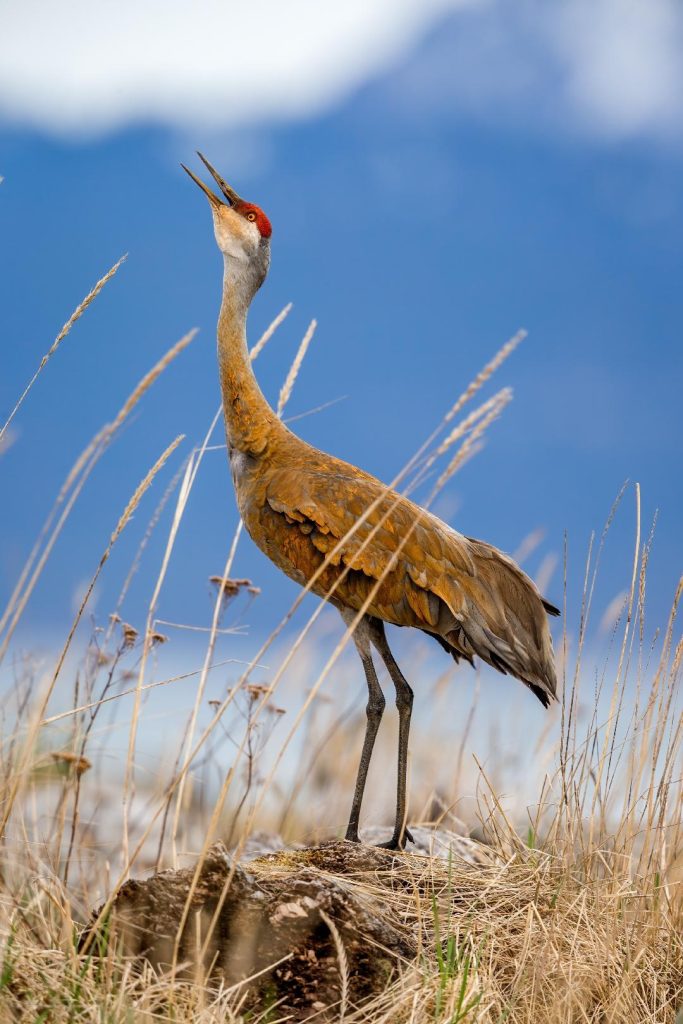
A Sandhill crane bugling during a stopover on Alaska’s Kenai Peninsula. Photo by Daniel Glenn.
What are the lessons cranes teach? Grace. Exuberance. Grit. Determination. The importance of rootedness balancing joy found in departure. Know-where spanning generations. As members of a world population numbering three quarters of a million, cranes are true cosmopolitans, reminders of the need for far-flung preserves and corridors linking them.
The honking string trails over Guilbeau Pass and the Continental Divide, weaker birds in the lee of the strong, rested ones flying point. The hearts of those in the diagonals beat slower, and they flap less often. In a chain reaction, strokes skip down the line; each captures miniature updrafts created by the wing pair ahead. This technique too is acquired. The energy savings resemble those of a child post-holing in snow in a parent’s footprints.
Some cranes prefer the arrow’s left edge and others its right, yet all frequently swap positions in a lofty version of musical chairs. They glide exactly three feet behind and three feet to the side of leading birds, in the aerodynamic sweet spot.
Snow and ice choke the high country this late, though less than they used to. Where the Rockies’ hyperborean stretch crooks west, drainages also switch. South-slope runoff blends with the Bering Sea while that from north faces dilutes the Arctic Ocean. On both sides of the flyway, rank upon craggy rank thrusts up as if supporting the raucous V, peaking in Mount Isto and Mount Michelson in the Romanzofs and Mount Chamberlin, bold solitaire of the Franklins, the Brooks Range’s grandest and most serene.
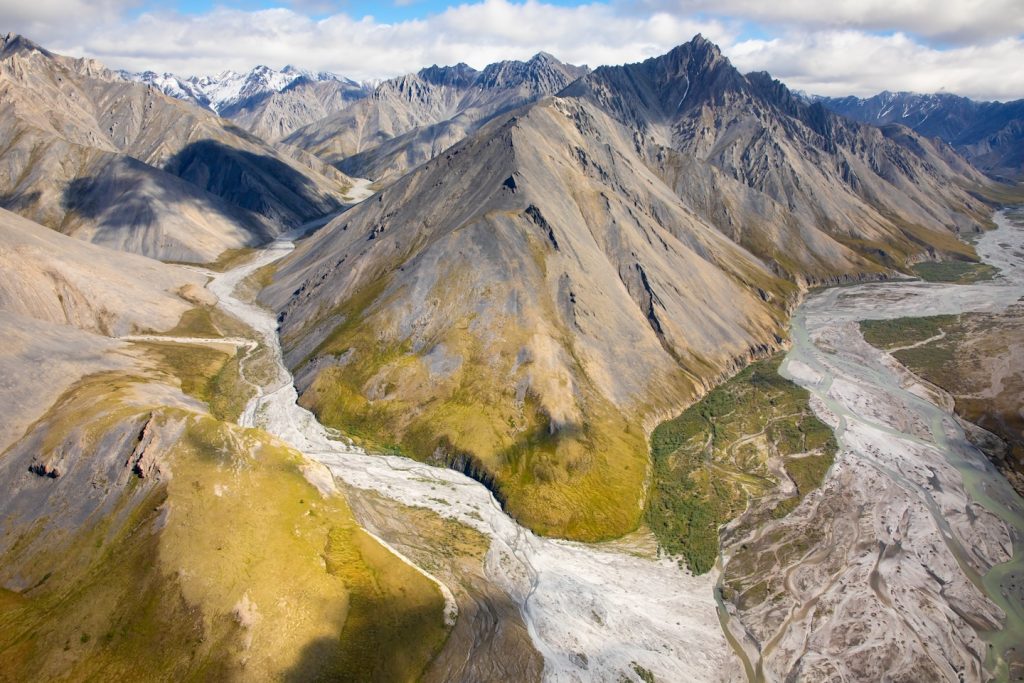
Northern Alaska’s Brooks Range as the cranes experience it. Photo by Lisa Hupp, USFWS.
To the east, Esetuk, one of few remnant glaciers, carved a swath through the mountains. With volume added from snowfields, it feeds Hulahula River tributaries.
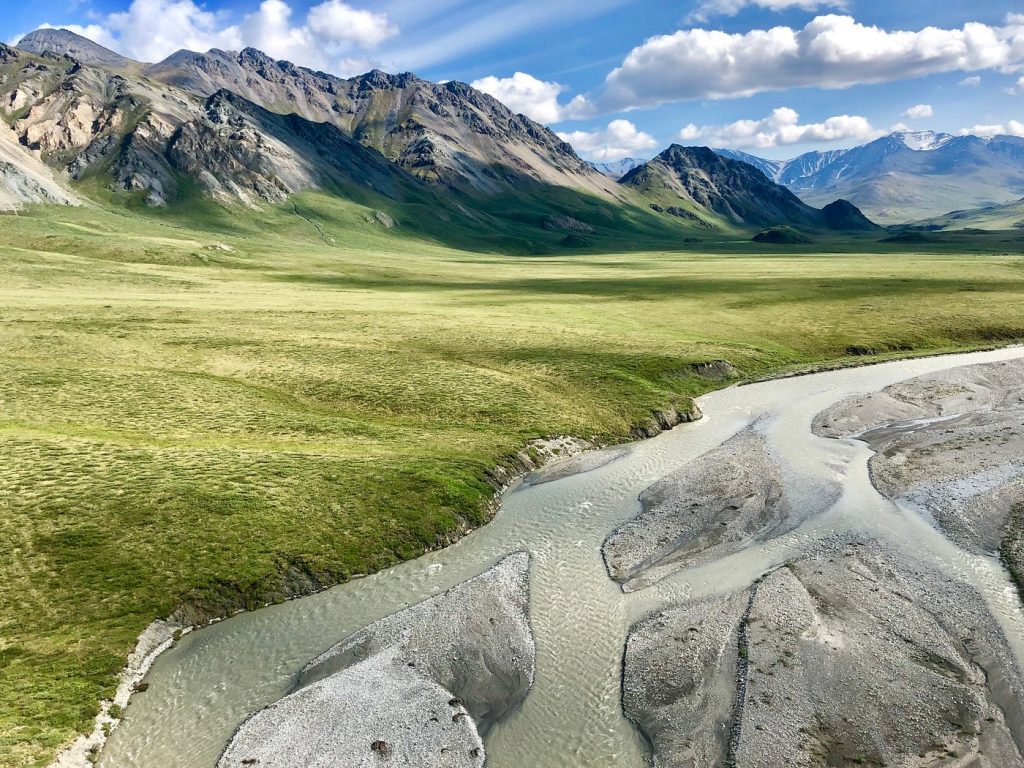
The Hulahula River at the northern margins of the Brooks Range, the beginning of the Arctic Coastal Plain. Photo by Danielle Brigida, USFWS.
Winter’s release wafts up to the cranes as headwaters susurrus. A gravel bar bush-plane strip, a few shacks on Native allotments at sapphire grayling haunts, and the old USGS Peters Lake research station cradled by summits yield the sole hints of human agenda in the birds’ field of vision. Tern colonies and Jack-in-the-Box-squirrel warrens are the refuge’s most populous homes. The closest road, the Dalton Highway, 100 miles to the west, shadows the pipeline to Prudhoe Bay.
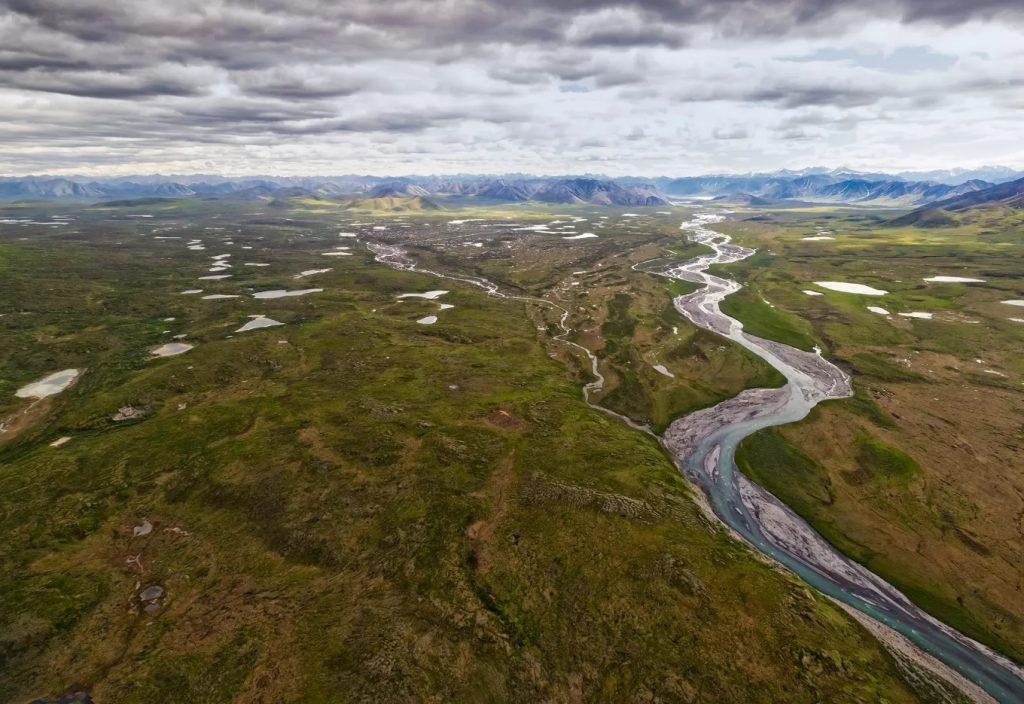
The coastal plain between the Dalton Highway and the Arctic Refuge, looking south, with the Brooks Range in the distance. Photo by Lisa Hupp, USFWS.
Before long, the range does run out—tectonic upheaval flatlines. Infinite space welcomes voyagers like a door flung wide open. From between foothills, the river spills onto the coastal plain. It twists unfettered, lazily, postponing oblivion in a steely sea. Its dendritic flows and deposits recall capillaries at times. Aufeis in sedimentary layers encases channels and bars where water rose and pooled atop ice and hardened, repeatedly, into armor against summer. It might last until snow falls again. Water so pure you can drink it from shallows, so cold it induces headaches, so clear it magnifies cobbles, slides around graveled bends. Ricocheting off bluffs, it braids and unbraids. Once in a while, it feathers into riffles or crests into rapids.
The cranes’ amber gaze beholds barrens coming alive, a sight unchanged since lions and mammoths combed steppe here; but the flock cannot hear arthritic old men’s grunts or cartilage clicking with each squelchy step. The very hills seem to be moving as thousands of caribou zero in on their destination. Tendrils of a flood, their vanguard seeks lanes of least resistance. Bodies press through a ford’s bottleneck, splash across to climb loamy cutbanks. Antlered bachelor bands surge overland, skirting the nursery with the same goal: fattening up for the fall rut and return to the tree line. Dense, gamey musk lingers downwind of the herd. Grizzlies and wolves in its wake hope for a meal for their young. Tooth and claw will distribute a share of this wealth.
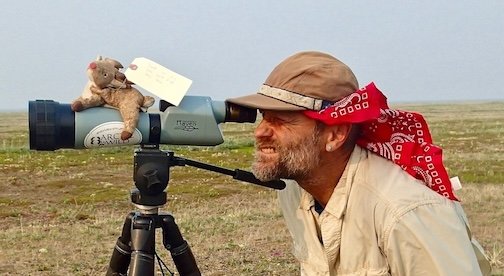
The author looking for caribou. Photo by Tuti Minondo.
Scientists and the Gwich’in fear declines of the herd mirroring slumps of others in Canada and Siberia. On average, the Arctic greens two weeks earlier than it used to, and pregnant cows reach the smorgasbord too late for their calves to take full advantage. Consequently, more, weakened offspring succumb to wolf packs, diseases, lone bears, parasites, or the elements. Still, the herd’s losses translate into predator gains only short-term, until starvation catches up with them. Premature warmth likewise cheats dunlins, plovers, and longspurs, which tuned their migrations so hatchlings can gorge on new mosquito crops. Can instincts honed over eons adjust fast enough to Earth’s quickening pulse? Will tweaked behaviors temper the inevitable?
The same questions, of course, probe our own fate.
A flock of cranes is called a “calamity” too, and on some level of their two-million-year-old consciousness, the relics that weathered prior extinctions may intuit trouble. Right now, different clues draw their attention: parallel ungulate freeways, ruts caribou cohorts wore into tundra.
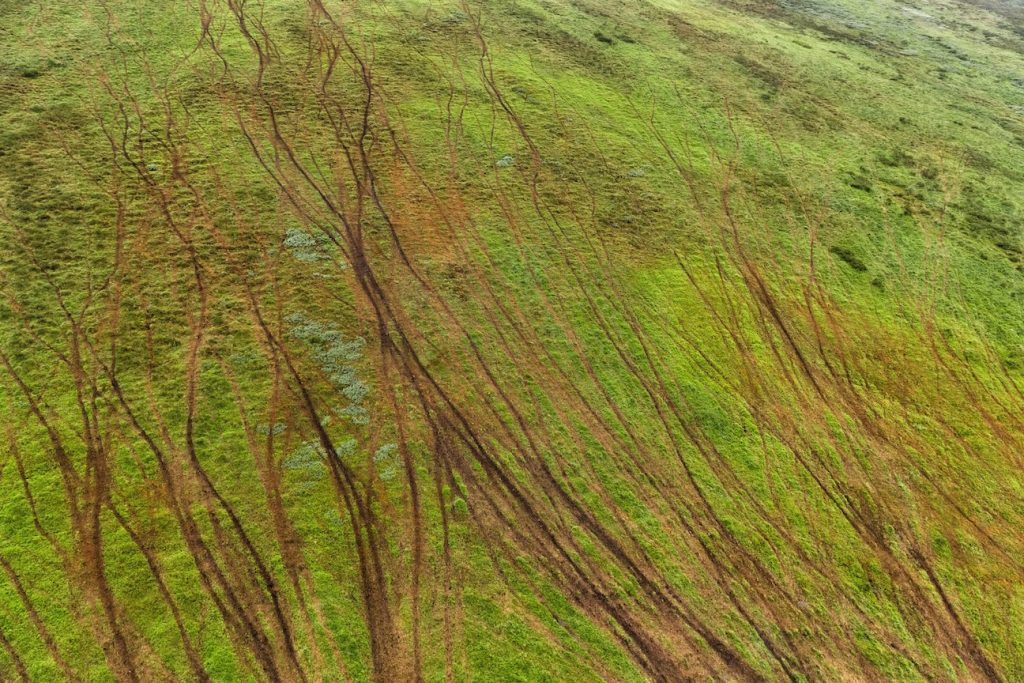
The trails of other epic migrants—caribou—in the northern foothills of the Brooks Range. Photo by Lisa Hupp, USFWS.
Hair strands adorn bushes at freshly churned furrows whose dung pellets enrich topsoil. Grizzlies lay down their own imprints, sometimes over centuries. Hikers are forced to step in those paw holes, to match strides and assume bearish swaggers.
From up high, the cranes can’t discern the abundance of ground cover, the tangled mat of forbs, lichens, mosses, heather, and grasses. Soon, blooming perennials will be splattered about like paint. River beauty will rouge cobbled flats. Moss campion stars will burst pink on its cushions, first on the southern pillowing, sun-kissed half. Poppies tracking the solar run—a circle almost fully visible by May—will nod in breezes, splashing lemon yellow among bleaching antlers nibbled by voles. Labrador tea pungent as smoke will scent the days. When the wind stops stirring willows clogging streambeds, the land exudes silence, not a void, but the fount of the high latitudes’ signature sounds: Loon laughter. Jaeger shrieks. Longspur jingles. The keening of gold-spangled plovers. These fragments of meaning, baring nerve endings, forever tinge memory.
Charged with constant light, the low-key vegetation sustains throngs of Arctic fauna unrivaled elsewhere. Statistics give just a pared idea of the bounty encountered in the refuge. Its obscure, far from secure boundaries harbor the greatest diversity of any of the circumpolar North’s protected regions. Forty-five mammal species live here at least seasonally, nine of them marine mammals. Roughly 180 bird species can be seen, some fulltime residents but largely breeders from six continents and each Lower 48 state. Thirty-five kinds of fish—most inhabiting offshore waters—round out the glorious list.
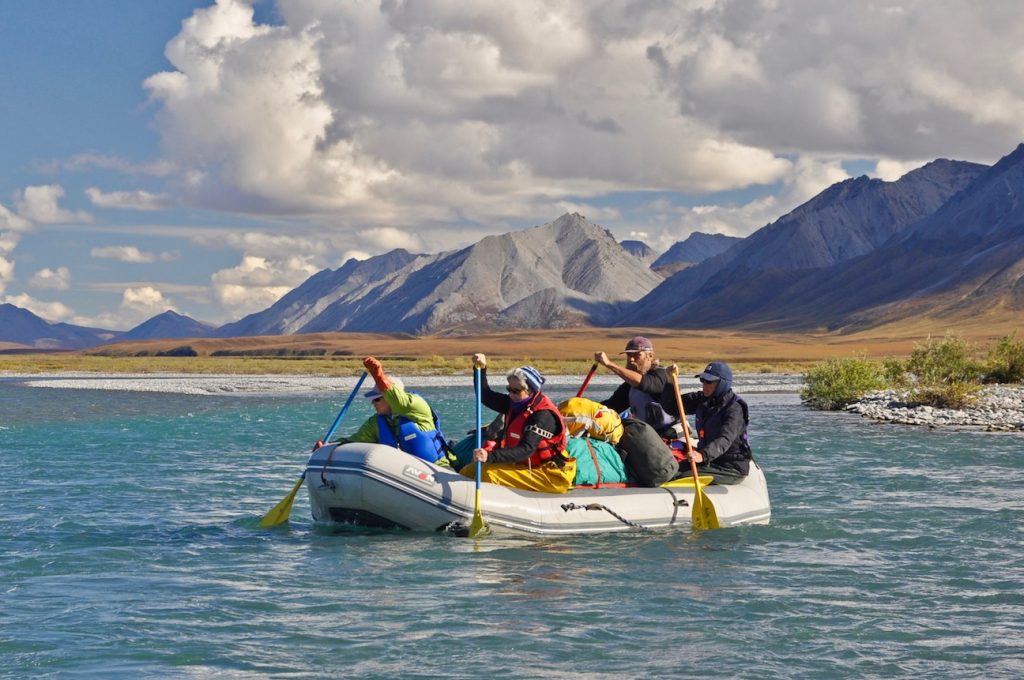
The author guiding clients on the Canning River, the Arctic Refuge’s western boundary, abutting petroleum lands. Photo by Rich Wilkins.
A set of interlocking ecological zones forms the matrix for all this fecundity. It contains boreal forest or “taiga,” piedmont and pinnacles, the coastal plain’s regal spread, deltas and marshes, and lagoons ringed by barrier islands, beaches, and spits. Smaller habitats marble these zones, stepping-stones for future climate refugees.
Leaving behind the Sadlerochits, ramparts cleaved from the Brooks Range’s bulk, the cranes are nearing the end of their epic quest. On the banks of the Hulahula, twin boulders shift, transformed into muskoxen grazing. Away from the river, permafrost arranged tussocks and soil polygons as beige-and-mint mosaics. Sunlight glints on melt ponds and on seepage in the frost fissures responsible for the strange symmetry. Scalloped from the horizon’s blue, Camden Bay marks North America’s line of surrender. Farther out still, flat as a griddle, floats Barter Island with the Inupiaq village Kaktovik, outpost in no longer reliably ice-clad tides. Beaufort Lagoon, toward the Canada border, promises transients safety and sustenance. Flurries of shorebirds and geese will congregate there in July and August to refuel for their trip south.
In February, polar bears and their cubs emerged from birthing chambers dug into snowdrifts along this littoral, the only 125 miles of Alaska’s 6,500-mile Arctic coast closed to oil drilling—until recently. With sea ice disappearing, more bears started denning on shore, where they’re vulnerable to pathogens, and to toxins and eviction from seismic testing and construction. At last count, the Southern Beaufort Sea sub-population numbered roughly 900 animals. Experts predict their demise by mid-century. A GPS-collared female with her yearling cub dog-paddled 426 miles across the Beaufort Sea. In search of an ice floe on which to haul out and rest, both spent nine days straight in barely above-freezing water. The cub did not make it to land. Luckier bears, after marathon swims, recover slowly.
On frozen turf, scarlet-browed pairs of cranes wearing gray already engage in displays reaffirming commitments. They curtsy and flutter and hop, shake fannies, their wings akimbo, like crazed ballerinas. Cocks and hens trumpet in unison at their best during the mating ritual. Dances performed year-round take center stage while they breed. The throaty duets and pas de deux weave tender bonds maintained for decades.
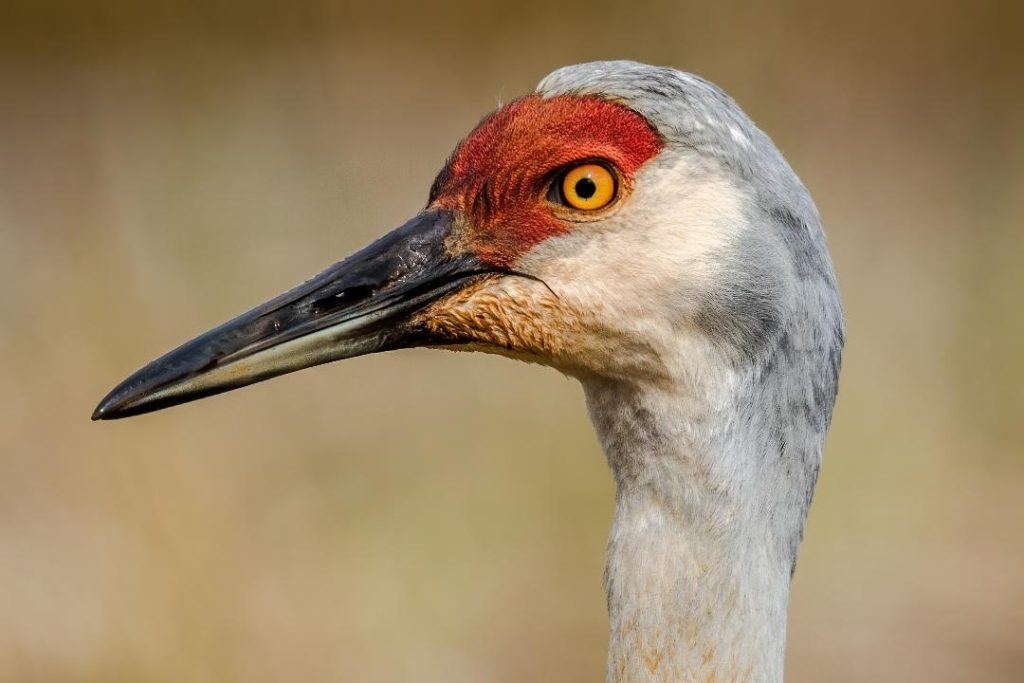
When sandhill cranes get excited, their red forehead skin patch expands. Photo by Daniel Glenn.
The blow-ins, ready to join in the frenzy, prepare for arrival. Keeping their formation, they bank, and then coast in at a low angle, bugling eagerly. At the last moment, one by one, they drop their landing gear, stall, fold up tired wings, and touch down, stilt-legged, awkwardly, perhaps even a little surprised.
Their weeks at pasture pass in a blur. Before they decamp, slipping away in sublime staggered files, life will begin again. Spindly “colts” will scrounge berries and bugs. The dance will continue.
If we can’t save the land, it cannot save us. Apart from our requirements, wild landscapes and creatures exist with autonomy and their own right to thrive. We need an ethic reflective of this. In fact, we have such an ethic, sketched by the Muries, Bob Marshall, Aldo Leopold, and Rachel Carson. They’re the elders who showed us indispensable flight paths.
Posterity will not judge us by what we built or by what we amassed but by what we failed to do. Besides being flesh and blood, feathers and bones, sinew and spirit, cranes signify opportunities. They are harbingers of hope, reminders that the worthiest journeys are journeys of daring. Do we dare to renounce one species’ supremacy? Do we dare to meet nature on nature’s terms? Can we leave some places alone? Can we, under epochal pressure, muster the courage of cranes?
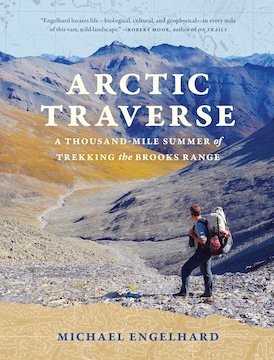
Michael Engelhard is the author of Arctic Traverse: A Thousand-Mile Summer of Trekking the Brooks Range, from which this essay was excerpted.
Trained as an anthropologist, he worked for 25 years as a wilderness guide and outdoor instructor in the canyon country and Alaska. Unable to stay away from the Southwest, like the Bosque cranes, he relocated to southern Utah again after living in Fairbanks, Alaska for many years. This latest migration resulted in No Walk in the Park: Seeking Thrills, Eco-Wisdom, and Legacies in the Grand Canyon.