
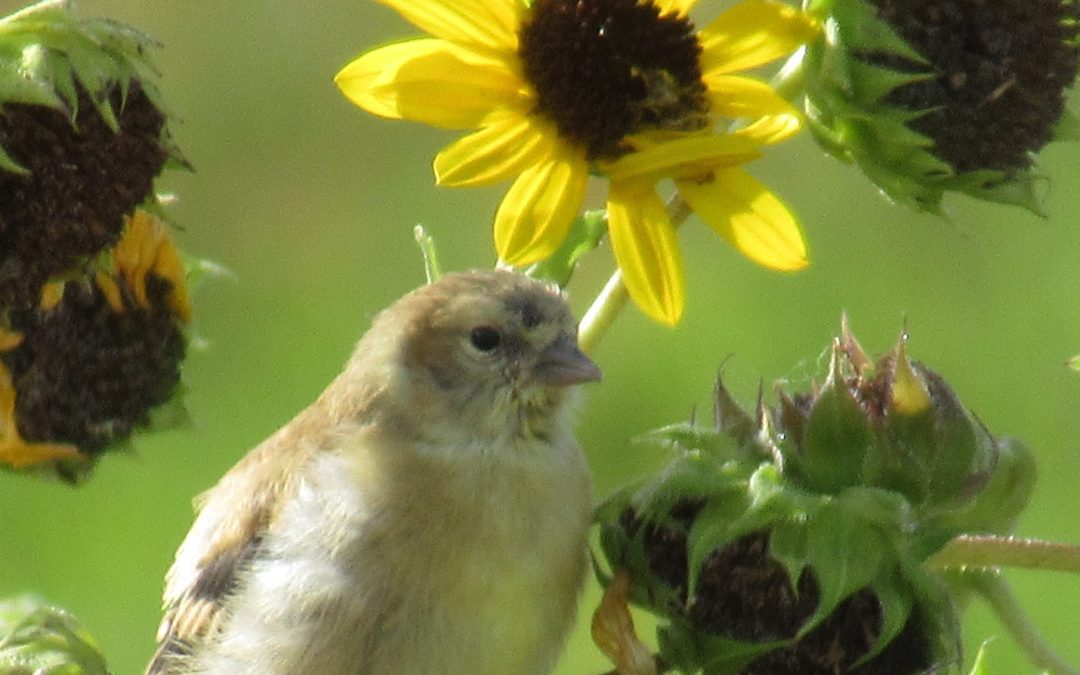
Fall American goldfinch in sunflowers.
It is September, and soon they will return. “Are they here yet?” “When do you expect them?” “Will they be there by (fill in a date)?” These are the most commonly asked questions at the visitor center this time of year.
And who is the “they” these questions allude to? Almost anyone who has been to Bosque del Apache or has heard of the refuge knows who “they” are. And while the sandhill cranes and snow geese are indeed the main attraction in the fall (a “transforming experience” I heard someone say of the morning lift-off recently), they are not the only ones arriving. Thousands of ducks will proceed the cranes, returning from their breeding grounds in the far north and the prairie potholes scattered across the middle part of the continent. In September, few of the males are in breeding plumage; looking instead much like the females. This is the time to practice the art of “jizz” identification – identifying the ducks by their shape and size and behavior, instead of their plumage. Ruddy ducks are small and round with broad, short bills. Northern shovelers are very large with a distinctive spoon-shaped bill, hence the nickname “spoonbills.” Almost all of the ducks have a distinctive size and shape that can be used for identification, and fall is a good time to study this without the distraction of the male’s bright plumage.
But there is another, more subtle, arrival also occurring in September – the songbirds. Their sheer numbers can rival the cranes and geese but mostly goes unnoticed because of their small size. Day break on crisp September mornings can find the woods and fields full of warblers and sparrows and other small passerine migrants touching down for a day of feasting after an overnight flight from the north. Bird song is everywhere as the flocks communicate and spread out to good feeding areas. Soon they will disappear into the vegetation and become silent as they refuel. Songbirds can double their weight in between evening flights as they stock up on fat and protein to sustain their long journeys from North American breeding grounds into the tropics, where many winter. Walk the tree line around the Flight Deck or along the Boardwalk for lingering shorebirds, or make one last trip looking for patches of sunflowers in bloom on the north Seasonal Road before it closes on October 1st.
An often-overlooked fall phenomena to experience is the sound of night migrants. Step out after dark on a clear, quiet night and just listen. Radar shows us that the fall sky can be filled with millions of migrating songbirds, all softly communicating with distinct flight calls that can be heard by anyone who is willing to just stand quietly and listen. Most of these birds are just passing through, staying a night or two at most. But some, mimicking the cranes and geese, will make Bosque del Apache their winter home – song, Lincoln, Brewer’s and white-crowned sparrows, marsh wrens, and rails, to name a few. Check out https://birdcast.info/ for migration maps in real time to see what is passing over your area tonight.
The excitement for a birder is the rare bird, the one that doesn’t get seen very often. In fall, these can be problematic, though, because of all the young of the year. The fall migration can have two to three times as many individuals as the spring migration because of these young. And most of these young do not look like the parents. Plus, just like the ducks, the males are no longer in their bright breeding plumage. Suddenly, every small bird is a little brown job (a “LBJ” in birding lingo). If sorting out LBJ’s is your cup of tea, you will experience nirvana at Bosque del Apache in September! If not, just sit back and enjoy the “spectacle” of the fall passerine migration. There could be worse ways of enjoying crisp, fall mornings when the leaves are starting to turn gold. And soon “they” will be arriving!