
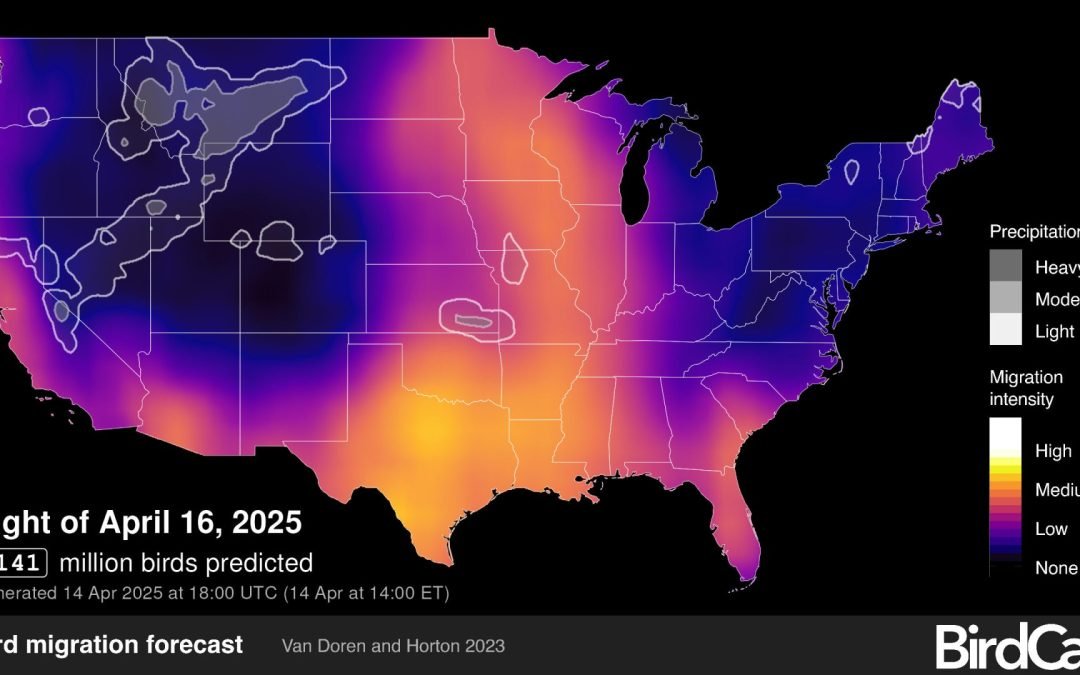
Graphic courtesy of BirdCast. Bird migration forecast maps, like this one for April 16, 2025, show predicted nocturnal migration three hours after local sunset and are updated every six hours. (Daily forecasts are produced by Colorado State University and the Cornell Lab of Ornithology and can be found online at birdcast.info.
Article by Alex Harper, expert birding guide and outdoor educator.
I’d like you to consider doing the following this spring: go to bed earlier than usual one night and set an alarm for well before sunrise. Prepare for a morning of birding, but this time pack a headlamp. Head out to the Bosque and find a quiet place to listen before the dawn chorus begins. If the conditions are right, you may hear the birds calling out into the darkness.
Annual animal migrations are as dependable as the earth is at circling around the sun, and that is because they are linked. The term migration refers to any seasonal long-distance movements in search of a resource such as food or for breeding opportunities. As Earth orbits the sun, it wobbles, creating what we experience as seasons. These seasons create opportunities for birds, as well as challenges.
For the cranes of Bosque del Apache, their arrival in late fall is driven by the need to find stable food sources in the right habitat. In the late winter when increasing day light and temperatures bring promise of the best conditions to raise young, they disperse to find the best locations to raise young, arriving during the best possible window to be successful at rearing the greatest number of young.
Cranes are among some of the only birds that migrate almost exclusively during the day. Cranes also migrate in groups with adult birds teaching young birds how to follow routes across the continent, traipsing valleys that spread out like webs across the continents. Songbirds, on the other hand, migrate mostly at night. Like cranes, they may well be using landmarks across their entire migratory routes to help them navigate and orient during their journeys.
Songbirds set off shortly after sunset when migrating long-distances. They’ll often fly all night and into the first daylight hours. When the weather conditions are right – ideally clear skies with a tailwind – birds will especially be on the move. With the ability to use the stars to navigate, they take advantage of the cooler temperatures and calmer atmosphere to head in the direction of whatever they’re seeking. Thrushes, warblers, and sparrows are especially noisy, and you may catch the “pweep” of a Swainson’s Thrush, or the faint, monosyllabic call notes of warblers or sparrows.

Orange-crowned Warbler | Photo by Alex Harper
 Buntings may be the easiest to pick out, with their buzzy “bzeet” calls penetrating the darkness. Flycatchers, vireos, kinglets, and wrens are among the songbirds that migrate at night, but they make little to no nocturnal flight calls. Swallows, Horned Larks and blackbirds are among the songbirds that migrate more during the day.
Upon daylight, birds on their journeys will descend their cruising altitude, often maintaining their trajectory as they survey the land for areas to rest, feed, and drink. You may see them flying a few hundred feet overhead or see them dashing between groves of mesquites and cottonwoods. This is sometimes referred to as a dawn flight. Migration comes in many shapes and forms, and birds have many tools and strategies. Written into their genes are instructions to migrate, signaled by hormones that are secreted in varying doses depending on the season. But they show the remarkable ability to learn as they go as well, demonstrating to us that they are actively learning. What better place than to ponder the magic of migration than on a still morning at the Bosque this spring, ears pointed to the stars before the first rays of light?
Together, we can help birds make it safely to their breeding grounds! Join the global effort to protect birds by:
- Dimming your lights. (Lights at night can be very disorienting to birds during their long spring migration. To help prevent deadly bird collisions, turn off or dim non-essential lights from 11pm to 6am.)
- Making glass windows visible to prevent collisions.
- Taking the pledge to protect birds.