
Weighing the risk and finding the reward

Sandhill Cranes at Bosque del Apache. Photo: Steve Aicinena
Written by Amanda Walker, Park Ranger and Claire Revekant, Senior Wildlife Biologist
My bags are packed, I’m ready to go. Go see the sandhill cranes at Bosque del Apache. Cranes who’ve just made a journey themselves – hundreds of miles across dozens of habitats.
In some ways, my journey may be simpler – I can pack the snacks I like and there are refueling stations frequently along my route that I can look up on my phone. Imagine that journey on the wing. Gliding over the mountains. The sunrise as an alarm clock. Not knowing what you’ll find beyond the next forest. Idyllic.
Similar to our journey by car or plane, migration has its own risks. What if the pond they stopped at last year is now a parking lot? What if a family of coyote have taken up residence at the field they fed in, the only field for a hundred miles? Instead of contemplating how to fix the change, as we might do, migrating birds must address the real issues: find food. Find water. Now.
Sometimes, there is a discovered reward in changing landscape – for some species anyway. A scrub-shrub habitat becomes a cornfield. A conservation area improves wetland habitat. Migrating cranes may not have used the previous habitat type, but they’re finding food in those new places now.
Landscape and climatic changes throughout the United States, especially along the Central Flyway, are altering routes and timing of migration for the Rocky Mountain Population and Mid-Continent Population of Sandhill Cranes. Warmer falls and winters mean these waterbirds can find open water in more northern areas (like Colorado and Utah) – they aren’t forced to move because their roosting, feeding, and loafing areas are still open. Some areas that historically may have been grasslands or wetlands are now growing cereal grains. For sandhill cranes, that would be like a new gas station being built along your travel route. Instead of moving on, the cranes find these fields and feast – further motivating them to stay where they are and not risk migration.
The historic floodplain of the Rio Grande (in Central New Mexico, known as the Middle Rio Grande Valley) is now home to hundreds of thousands of people, a variety of land managers, and seasonal wildlife, such as migrating cranes and snow geese. For those cranes, geese, and ducks that do make their way to the Middle Rio Grande Valley, they find a variety of food and water options. Some of those land managers even grow food intentionally for overwintering birds, such as Bosque del Apache National Wildlife Refuge (managed by the US Fish and Wildlife Service) and Bernardo Wildlife Management Area (managed by the New Mexico Department of Game and Fish).
On their recent winter journeys, sandhill cranes and snow geese have encountered warmer temperatures and a variety of food and water options. They are finding winter food closer to where they’ve spent the summer. Their self-powered migration doesn’t have to be as risky. They are finding more options for food throughout the Middle Rio Grande Valley. They can spread out, reducing risk for disease. Though probably not intentional, they are weighing risks and finding rewards.
My own destination is still Bosque del Apache. I can welcome the cranes, geese, ducks, raptors, and songbirds back to the Middle Rio Grande Valley and enjoy the scenic Chupadera Mountains and relish the cold sunrises as I observe the birds who’ve made the journey. I’ve found a new reward.
Footnotes/FAQ’s:
Where’s the corn?
Sandhill cranes will eat a variety of foods throughout the year – insects, amphibians, roots, small mammals, cereal grains, and other seeds. Bosque del Apache has historically grown corn to help supplement the diet of overwintering geese and cranes. However, over the past few years, our corn yields have decreased due to a variety of reasons. Moving forward, Bosque del Apache plans to grow more drought-tolerant and salt-tolerant cereal grains (such as triticale and milo), as well as work to improve the soil health in some of our agricultural fields. Much of the agriculture improvements and research are being funded through the Friends of Bosque del Apache. Look for more information in a future Bosque Watch newsletter! There is absolutely food at Bosque del Apache for cranes and geese, though they are finding sources of food in other areas of the Middle Rio Grande as well!
For more information about crane numbers and farm operations on the refuge published in 2023, please check out the Friends of Bosque del Apache NWR website.
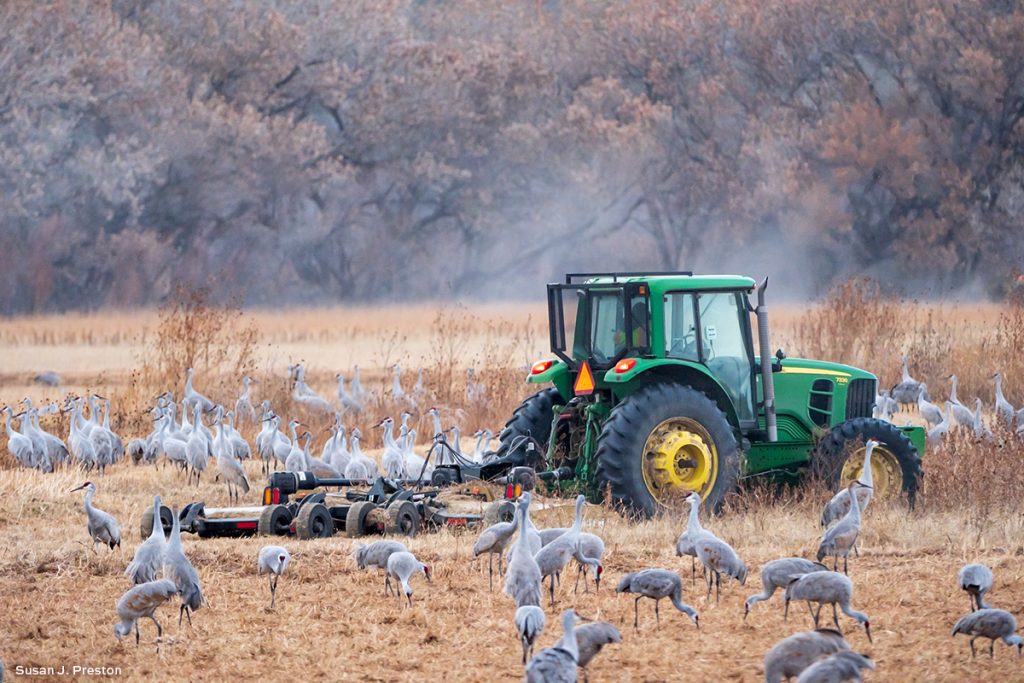
A tractor mows through a field of triticale on Bosque del Apache NWR as a flock of cranes looks on. Photo: Susan J. Preston
Are sandhill crane populations healthy?
Yes, sandhill crane populations across the United States are stable given the natural ebb and flow of wildlife populations. The Rocky Mountain Population (RMP) of greater sandhill cranes (most of which winter in the Middle Rio Grande Valley (MRGV) and rely heavily on the MRGV during migration and as a wintering range), have experienced some population increases in the past few years. In fact, 2023 survey efforts recorded the highest population estimates since pre-migration staging survey efforts began in the 1980’s. Above average recruitment following the 2023 breeding season was also reported for the RMP sandhill cranes. The Mid-Continent Population of sandhill cranes, a population of sandhill cranes that also winter in the MRGV, are doing well and numbers remain stable with natural fluctuations in population numbers.

Sandhill cranes feed in a field of triticale, a drought-tolerant grain. Photo: Susan J. Preston
Where are the cranes and geese this winter season?
Landscape changes and warmer winter temperatures across much of their migration route means that options for food and open water have increased resource alternatives for these waterbirds. This causes them to spread out across the landscape a bit more (though they may concentrate at certain areas within that broader area). Thousands of cranes and geese have been observed at Bosque del Apache this winter, though they may be in areas secluded from the public and move around to sites off-refuge at different times of the day.
Is it still worthwhile to visit Bosque del Apache?
Yes! In the past week (since February 7, 2024), over 100 species of birds have been reported on the refuge, and some wetlands will still be flooded until May. Large murmurations of blackbirds, flocks of wild turkeys, hunting raptors, and fields covered in ducks have been the highlights for some visitors! Observations of javelina, mule deer, raccoon, and even elk have delighted visitors around the tour loop as well. As we head into spring, shorebirds and songbirds will make their way through the Middle Rio Grande Valley, on their way to northern breeding grounds. Volunteer naturalist-led refuge tours are seasonally offered – check our website for more information.

Bosque del Apache provides refuge and resources for countless species, like this mule deer feeding on screwbean mesquite. Photo: Lowell Hobbs
How can I help?
Learn more about what’s going on at Bosque del Apache! Updates about projects are available through the Friends of Bosque del Apache Bosque Watch newsletter, as well as on the refuge website.
Where’s the water?
Water on the Bosque del Apache landscape is very seasonal. You may notice that water locations change with winter visits just a few weeks apart! This movement of flooding management units throughout the winter instead of all at once helps refuge staff be strategic about making food available in accordance to waterbird usage with a limited water supply. Learn more about what happens at Bosque del Apache on our website.